

Law firms used to rely on structured, linear workflows: plan first, execute later, review at the end. But today, this model of working is unable to keep up.
Law firms are now borrowing a practice from the tech world known as Agile project management.
It’s becoming a game-changer for firms that want to increase efficiency and client satisfaction.
Keep reading to know what it can do for your legal practice.
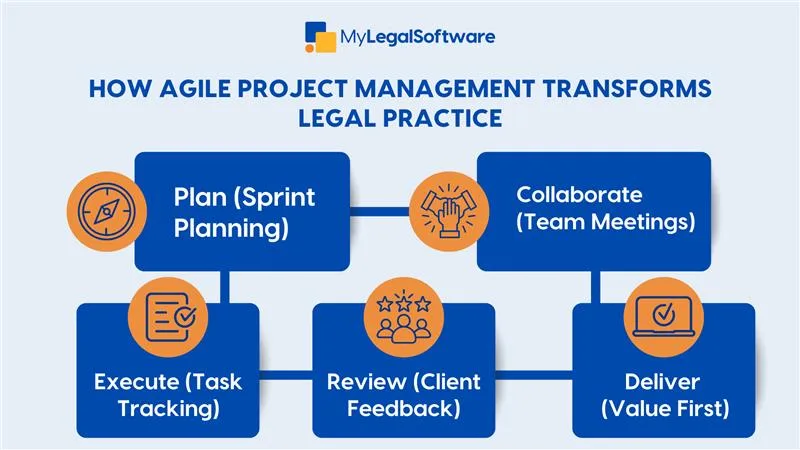
Agile Project Management in Law
Agile started in software development, but its principles fit surprisingly well in legal practice. Agile means breaking big projects into smaller, manageable tasks.
Instead of working in long, drawn-out phases, lawyers use sprints, which are short cycles of focused work, to deliver results faster and adjust along the way.
The result is faster work, more flexibility, and happier clients.
Why Law Firms Are Using Agile Practices
Traditional case handling is rigid. You plan everything upfront and hope for the best. Agile turns that on its head.
Here’s what makes it work in a law firm:
- Better collaboration: Teams communicate daily, just like Agile tech teams do. Everyone knows who’s doing what and when.
- Faster turnaround: Cases move forward in small, measurable steps, helping firms spot issues early.
- Improved client visibility: Clients see updates more frequently and can give feedback before it’s too late.
- Reduced burnout: Breaking projects into smaller parts helps attorneys manage workloads without chaos.
Agile helps firms stay responsive in a world that changes by the day.
Agile Methods Lawyers Can Use
Here’s how to apply legal Agile methods in daily practice:
- Daily stand-ups: Short check-ins to align tasks and priorities.
- Kanban boards: Visual dashboards that can be digital or physical. They showcase progress at a glance.
- Sprint planning: Break big matters into smaller deliverables with realistic timelines.
- Retrospectives: After each sprint, review what worked and what didn’t. Then improve.
These simple techniques can dramatically improve law firm project agility, especially when combined with the right software.
Technology in Agile Legal Operations
You can’t run Agile on sticky notes alone. You need tech that supports it.
Modern law firm software now includes tools built for Agile-style workflows, such as task boards, time tracking, shared dashboards, and real-time updates.
With the right system, you can:
- Assign and track cases in sprints.
- Communicate with clients inside the platform.
- Monitor progress with automated reports.
- Adjust deadlines instantly when priorities shift.
This way, agile legal operations become more of a management strategy and a competitive advantage.
Payoff for Attorneys
Lawyers who apply agile methodology in law are likely to get:
- Better control over cases without micromanaging.
- Fewer missed deadlines thanks to improved visibility.
- Happier clients because communication flows better.
- Higher productivity across teams.
Work Smarter with MyLegalSoftware (MyLS)
Agile isn’t just for software developers anymore. It’s for attorneys who want to move faster and deliver better results.
When law firms adopt Agile principles and combine them with an efficient legal case management tool, like MyLegalSoftware, they gain a serious competitive edge.
Ready to make your firm more agile?
MyLegalSoftware makes it easy to organize workflows, automate routine tasks, and deliver faster results for your clients, all in one secure platform.
Find out how MyLS supports agile project management for law firms today.
Start a Free Trial, or Schedule a Demo.

Frequently Asked Questions
What is Agile Project Management in Law?
Agile project management in law is a flexible approach to legal work that uses small, iterative stages rather than rigid, linear planning. It encourages collaboration and continuous improvement by allowing attorneys to adjust strategies as client needs or case conditions change.
How can lawyers apply Agile methods in their practice?
Lawyers can apply Agile law firm practices by breaking large matters into smaller, manageable tasks. They can use Kanban boards to track progress, hold daily stand-ups for quick team updates, and review performance after each sprint. These methods improve communication and client satisfaction.
What are the benefits of Agile methodology for lawyers?
The benefits of Agile methodology for lawyers are:
- Fast project delivery and few delays
- Improved collaboration between attorneys and staff
- Enhanced client communication and satisfaction
- More flexibility when priorities or case details change
- Higher transparency across the firm’s workflow
How can law firms use the Kanban method?
Kanban is a visual Agile method that helps teams manage workflow efficiently. Law firms use Kanban boards to see tasks at different stages, such as “To Do,” “In Progress,” and “Completed.” It makes matter management more transparent and keeps every team member aligned.
Can Agile improve legal workflow management?
Legal workflow improvement is one of Agile’s strongest advantages. By using sprints, reviews, and visual tracking tools, law firms can simplify their processes and ensure every step adds measurable value to the client.
Is Agile fit for all law firms?
Most law firms, including solo practices and large legal departments, can benefit from agile legal operations. Routine areas like document review or billing will benefit from the automation and structure. Complex matters such as mergers, litigation, or multi-party cases benefit from Agile’s flexibility and responsiveness.
How does Agile impact client relationships in law firms?
Agile fosters stronger client relationships by keeping clients engaged throughout the project instead of waiting until completion for updates. Regular reviews and transparent communication mean clients understand progress and trust that their legal team is adapting quickly to their needs.
How does technology support Agile project management in law?
Modern legal case management software makes Agile possible in practice. Tools like MyLegalSoftware allow lawyers to manage matters, track progress, assign tasks, and communicate with clients, all in one platform. Technology introduces Agile principles into everyday workflow.
What’s the first step to becoming an Agile law firm?
Choose one team or case to pilot Agile law firm practices. Introduce a Kanban board, hold short sprint meetings, and use feedback to refine your process. Once you see improvements in communication and turnaround time, gradually increase Agile methods across your firm.
Can MyLegalSoftware help law firms adopt Agile practices?
MyLegalSoftware can provide a digital foundation for Agile law firm operations. It centralizes matter management, billing, court calendars, client communication, and document sharing. It can help attorneys apply Agile principles effectively and improve client service delivery.