It usually starts with a small moment.
A client emails asking for clarification on a clause you remember negotiating. You open your folders, confident that it will take 30 seconds. Then five minutes pass. Then ten. You find three versions of the agreement, all slightly different; none is clearly marked as final. Someone else might have the signed copy. Or maybe it’s buried in an old email thread.
Nothing here feels dramatic. No mistake was made. No rule was broken.
Still, the confidence you had at the start of the conversation is gone.
This is what agreement breakdown looks like in real practice, not as a crisis, but as friction. And most of the time, that friction isn’t caused by attorney error. It’s caused by process gaps, specifically, the absence of intentional agreement management.
Many firms don’t call it that. They just feel the stress of it, day after day.
Why Agreements Create More Risk Than Attorneys Expect
Unlike cases, agreements don’t end cleanly.
They continue to govern relationships long after the file is closed. They trigger obligations months or years later. They get referenced when memories have faded, and staff have changed. Yet they are often handled with far less structure than pleadings or filings.
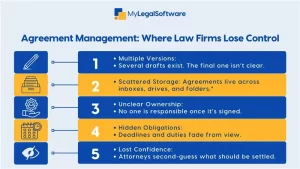
As agreements move through drafting, review, revision, signature, and follow-up, they pass through inboxes, desktops, shared drives, and different hands. Each handoff introduces uncertainty. Each version introduces doubt.
When agreement management is informal, risk doesn’t appear immediately. It accumulates quietly. Deadlines get tracked in someone’s head. Responsibilities become assumptions. Visibility disappears, even though the agreement itself still carries legal weight.
That’s where exposure begins.
Agreement Management Is Not Just Filing, It’s Accountability
Many attorneys think agreement handling is about storage. Where is the document? Who saved it? What folder is it in?
But the real issue is ownership.
Who is responsible for the agreement right now? Who is responsible after it’s signed? Who is watching for what comes next?
Without clear answers, agreements float. Attorneys lose oversight not because they stop caring, but because the process never made responsibility explicit. Over time, agreement management becomes reactive. Attorneys respond when something goes wrong instead of guiding the agreement through its lifecycle.
The danger here isn’t negligence. It’s invisibility.
Where Traditional Contract Handling Quietly Fails You
Email feels fast, until it isn’t.
Shared drives feel organized, until they aren’t.
Every firm eventually hits the point where “search” returns too many results and certainty disappears. The infamous Final_v7_REALLY_FINAL document isn’t a joke because lawyers are careless. It exists because traditional systems weren’t designed to reflect how agreements actually evolve.
This is often where firms look to contract document management, hoping technology will solve the chaos. But the real pain isn’t technical. It’s cognitive. Attorneys are tired of second-guessing themselves. They’re tired of rechecking work that should already be settled.
The stress comes from not knowing whether the agreement you’re looking at is the one that actually matters.
How Agreement Management Supports Better Client Relationships
Clients may never ask how you store agreements, but they feel the impact when clarity slips.
They expect attorneys to know what was agreed to, what obligations exist, and what happens next. When answers are delayed or uncertain, confidence erodes. Even small hesitations can create doubt, especially when agreements involve ongoing responsibilities.
Strong agreement management protects client trust by making follow-through visible and reliable. This is where customer contract management plays a role, not as a sales function, but as an expectation. Clients want to feel that their agreements are actively overseen, not passively stored.
When attorneys maintain clear agreement oversight, conversations feel steadier. Advice sounds more certain. Trust deepens without effort.
Final Thoughts: Agreements Should Reduce Risk, Not Create It
Agreements are meant to bring certainty. When handled without structure, they do the opposite.
Most firms don’t need stricter rules or more reminders. They need systems that reflect reality: how agreements move, how responsibilities shift, and how long obligations last. When agreement oversight is intentional, attorneys regain control without adding complexity.
This is where MyLegalSoftware (MyLS) fits naturally into modern practice. Built for immigration attorneys and general practitioners, MyLS supports legal matters from first client contact through resolution, helping firms maintain agreement visibility without disrupting how they work. With a 14-day free trial, you can evaluate fit without pressure.
Strong agreement management isn’t about technology. It’s about peace of mind. And that’s something every practice deserves.

Frequently Asked Questions
What is agreement management in a legal practice?
Agreement management in a legal practice refers to how attorneys oversee agreements throughout their entire lifecycle, from drafting and negotiation to execution, follow-up, and long-term obligations.
Why do agreement-related issues lead to client disputes?
Most client disputes don’t come from bad intentions or poor legal advice. They come from misalignment: missed clauses, unclear responsibilities, or forgotten deadlines. When agreement oversight is inconsistent, attorneys may rely on assumptions instead of certainty.
Can agreement management work for small or solo law firms?
Absolutely. In fact, small and solo firms often feel agreement-related strain more acutely because fewer people are sharing the workload. When everything lives in one attorney’s head or inbox, the risk of oversight increases. Agreement management helps smaller practices create structure without adding complexity, allowing attorneys to stay organized even as matters grow more demanding.
How does agreement management fit into existing legal workflows?
Agreement management works best when it aligns with how attorneys already operate. Agreements touch intake, billing, compliance, and case resolution, so they should move alongside the matter, not separately from it.