AI enhances legal contract drafting by reducing drafting time, identifying risk earlier, improving clause consistency, and supporting attorneys with data-driven suggestions, without replacing legal judgment.
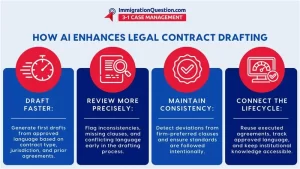
In practice, AI helps you draft faster, review more precisely, and maintain consistency across growing volumes of contracts.
As client expectations accelerate and tolerance for error shrinks, contract drafting is no longer just about legal accuracy; it’s about operational control. Understanding how AI actually fits into this process is now a practical requirement, not a future consideration.
Where AI Adds Real Value in Contract Drafting
The most immediate value of AI in contract is at the beginning of the process. First drafts no longer need to be built from scratch or copied manually from prior agreements.
AI can analyze previously approved contracts and suggest starting language that aligns with the jurisdiction, contract type, and practice area you are working in.
As drafts evolve, AI continues to add value by acting as a second set of eyes. It identifies inconsistencies between clauses, flags missing provisions, and detects language that may conflict with other parts of the agreement.
This does not eliminate review; it strengthens it. You are able to focus your attention on substantive issues rather than mechanical ones.
Collaboration also improves. When multiple attorneys or teams work on related agreements, AI helps maintain consistency across documents.
Language drift, outdated clauses, and version confusion become easier to spot before they create downstream issues. This is where AI contract drafting becomes less about speed and more about control.
How AI Contract Software Improves Accuracy And Consistency
Inconsistency is one of the most common sources of contract risk, especially in firms handling high volumes of similar agreements. Even experienced attorneys can overlook small deviations when working under time pressure or across multiple versions.
AI contract software addresses this by learning your firm’s preferred language over time. It recognizes patterns in approved clauses and alerts you when a draft departs from those standards.
This does not mean every deviation is wrong. It simply ensures that deviations are intentional, visible, and reviewed.
By reducing reliance on manual copying and memory, AI lowers the likelihood of human oversight errors. It also helps junior attorneys align more quickly with firm standards, while giving senior attorneys greater confidence that those standards are being followed consistently.
Importantly, AI supports accuracy without flattening nuance. You decide when exceptions are appropriate. AI ensures that those exceptions are deliberate rather than accidental.
Why Drafting Improves When Contract Management Is Connected
Drafting quality is closely tied to how contracts are stored, organized, and reused. When prior agreements are difficult to locate or search, attorneys are more likely to reinvent language or rely on outdated templates.
This is where AI contract management becomes part of the drafting conversation. When contracts are searchable by clause, obligation, or matter type, drafting becomes faster and more precise.
When executed agreements are tracked and structured, they become reliable reference points rather than static files.
AI helps connect drafting to the broader contract lifecycle. Language used during negotiation informs future drafts. Approved clauses are easier to reuse.
Institutional knowledge remains accessible even as teams change. Drafting becomes a continuous process rather than a series of disconnected tasks.
What AI Does Not Replace in Legal Contract Drafting
Despite its benefits, AI has clear limits, and recognizing those limits is essential.
AI does not replace legal judgment. It does not negotiate on your behalf. It does not understand client objectives or business context the way you do. It does not assume ethical responsibility or professional accountability.
All final decisions remain yours.
AI’s role is to surface information, patterns, and potential issues so that you can exercise judgment more effectively. Used properly, it strengthens attorney authority rather than undermining it.
How AI Legal Contracts Fit Into Modern Legal Operations
AI-supported drafting is most effective when it is treated as one component of a connected legal system. Contracts intersect with matters, deadlines, communications, and client records. When drafting tools operate in isolation, their value is limited.
When drafting, document management, and case workflows are connected, attorneys gain a clearer view of how contracts fit into the broader progression of a case. AI then supports not just drafting efficiency, but operational clarity.
AI Works Best Inside a Connected Legal System
AI enhances legal contract drafting by improving speed, consistency, and early risk visibility, without replacing the attorney’s role in judgment, strategy, or accountability.
Its real value emerges when drafting is connected to how contracts are managed, reviewed, and reused over time.
That is why systems like ImmigrationQuestion.com 3-1 case management focus on unifying documents, workflows, and case progression in a single environment.
When AI-assisted drafting is embedded within a broader legal system, it becomes a practical advantage rather than a standalone tool.
As contract work continues to scale in volume and complexity, the attorneys who benefit most from AI will be those who use it to reinforce standards, not shortcut them.

Frequently Asked Questions
1.How accurate is AI in legal contract drafting today?
AI is effective at pattern recognition, consistency checks, and issue flagging when trained on quality data. Accuracy improves significantly when AI output is reviewed by attorneys.
2. Can AI draft contracts without attorney review?
No. Attorney review remains essential for legal interpretation, negotiation strategy, and ethical responsibility.
3. Is AI contract drafting ethical for law firms?
Yes, when used with transparency, oversight, and compliance with professional obligations.
4. What types of contracts benefit most from AI assistance?
High-volume and repeatable agreements, such as service contracts, employment agreements, NDAs, and commercial templates.
5. How does AI reduce risk in contract drafting?
By identifying inconsistencies, missing clauses, and deviations from preferred language earlier in the drafting process.
6. Should small firms consider AI legal contract tools?
Yes. Small firms often see significant gains in efficiency and consistency, especially when resources are limited.