

“How do you bill?” is often asked before “Can you help me?” before “What’s your experience?” and before any discussion of legal strategy. Clients want to understand their financial commitment before committing to you as their attorney.
Billing structure now shapes client trust before legal strategy ever gets discussed. Your fee model signals transparency, predictability, and how you value your work. It tells clients whether you understand their concerns about cost and uncertainty.
Attorney billing programs serve as the silent backbone supporting these modern fee structures that clients increasingly demand.
Why Legal Billing Models Are Changing in 2026
Clients expect predictability and transparency more than ever. They’ve been trained by subscription services and flat-rate pricing in other industries. Legal billing feels like the last holdout of opaque, unpredictable costs. They want to know what things cost upfront, not after the work is done.
Firms want steadier cash flow, too. Monthly recurring revenue beats the feast-or-famine cycle of large retainers followed by collection struggles. Predictable income enables better planning, hiring, and growth.
Courts, regulators, and competition are raising the bar. Fee disclosure requirements tighten. Online legal services offer transparent pricing. Clients compare providers based on billing clarity.
Your billing model is part of your competitive positioning, whether you treat it that way or not. Modern attorney billing programs help firms meet these evolving expectations systematically.
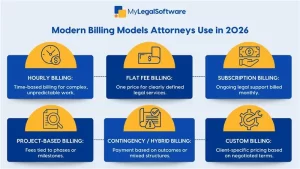
Why Billing Types Matter More Than Billing Rates
Rates don’t fail firms; mismatched billing models do. Charging $300 per hour isn’t the problem. The problem arises when you bill hourly for work clients expected to be covered by a flat fee, offer flat fees without proper scoping, or use contingency structures in cases that don’t support them.
The wrong billing structure causes write-offs when clients dispute bills. It creates conflicts when expectations don’t match reality. It leads to burnout when you’re working without appropriate compensation because you misestimated the scope.
These failures happen regardless of your hourly rate. Attorney billing programs that support multiple billing models help you match structure to case type appropriately.
The Core Legal Billing Models Attorneys Use in 2026
-
Hourly Billing: Still Common, No Longer Simple
Hourly billing still makes sense for complex litigation with an unpredictable scope, for matters requiring extensive discovery, or for cases where it is genuinely impossible to estimate time accurately up front. However, client friction around hourly billing has intensified.
Time-tracking pressure affects attorneys constantly. Every six-minute increment requires documentation. Every task gets scrutinized. Clients question every entry that isn’t immediately obvious.
This creates stress and defensiveness that damages relationships. Hourly billing fails without strong attorney billing programs that make time tracking effortless and invoicing transparent.
-
Flat Fee Billing: Predictability Clients Appreciate
Flat fees work well for work with a defined scope, such as immigration applications with clear document requirements, standard motion practice, initial consultations, or services you’ve performed enough times to estimate accurately. Clients appreciate knowing exactly what they will pay.
The risk lies in underpricing. If you estimate three hours but the work takes seven, you lose money. When the scope expands beyond what you anticipated, you may be working without pay unless your agreement addresses scope changes.
Structured tracking within attorney billing programs helps you understand actual time investment, even when billing flat fees, so you can adjust pricing over time.
-
Subscription Billing:for Ongoing Legal Support
Monthly retainers and advisory services generate recurring revenue while providing clients with ongoing access to legal support. This model works well for business clients who need regular counsel without full-time representation, families seeking continuous immigration status monitoring, and individuals who require ongoing guidance as their situations evolve.
Subscription billing suits attorneys focused on building long-term client relationships, but it fails when the scope is unclear, or clients consume more time than anticipated. Older attorney billing systems often struggle with the recurring billing mechanics these models require, while modern platforms handle them seamlessly.
-
Project-Based Billing: Defined Scope, Defined Value
Project billing differs from flat fees through milestone-based pricing. You bill as phases are completed rather than one lump sum. Clients see progress tied directly to payments. You manage cash flow better throughout longer engagements.
Managing scope creep remains critical. When projects expand beyond initial agreements, billing adjustments must happen quickly and clearly. Milestones and systematic tracking prevent disputes about what was included in original pricing.
-
Contingency and Hybrid Billing Models
Personal injury practices rely on contingency fees. Some matters combine hourly rates with success bonuses. Others mix flat fees for specific services with contingency percentages on recoveries. These hybrid structures require careful ethical compliance and clear client communication.
Flexibility in billing infrastructure becomes essential. Your system needs to track time even when you’re not billing hourly. It must calculate percentages accurately. It has to document fee agreements thoroughly to protect both you and your clients.
-
Custom and Client-Specific Billing Arrangements
Enterprise clients often negotiate fee structures tailored to their specific needs, including volume discounts, blended rates across practice areas, and alternative fee arrangements tied to outcomes or efficiency metrics. A one-size-fits-all billing approach no longer works when sophisticated clients expect customized solutions.
Adaptable systems protect your margins by tracking profitability across different fee structures. You need clear insight into which billing models work financially before committing to additional client-specific arrangements.
Billing Is Part of Your Client Experience
Billing reflects professionalism, clarity, and respect for clients. Confusing invoices signal disorganization. Surprise charges damage trust. Inflexible billing models suggest you care more about your convenience than client needs. Getting billing right matters as much as getting legal work right.
ImmigrationQuestion.com 3-1case management supports immigration attorneys and general practitioners through providing comprehensive features, which include flexible billing aligned with modern structures. The platform manages cases from first client contact through resolution, using billing tools that adapt to hourly, flat fees, and hybrid models naturally.
Ready to see how integrated systems improve both legal work and billing clarity? ImmigrationQuestion.com offers a 14-day free trial. Experience whether modern case management really does simplify billing while improving client relationships.

Frequently Asked Questions
What billing model works best for small law firms in 2026?
No single model fits all firms. Match billing to case types: flat fees for routine matters, hourly for complex and unpredictable work, subscriptions for ongoing advisory relationships.
Can attorney billing programs support multiple billing types at once?
Quality modern systems handle hourly, flat fee, subscription, project-based, and hybrid billing from one platform, letting you choose appropriate models case-by-case.
Is hourly billing becoming obsolete?
No. It remains appropriate for complex, unpredictable matters. But clients increasingly prefer alternatives when the scope can be reasonably estimated upfront.
How do subscription billing models affect client relationships?
Positively, when scoped properly. Clients appreciate ongoing access without per-call billing anxiety. Relationships deepen through continuous engagement rather than transactional interactions.