
You switch platforms mid-year. The migration breaks half of your client records. Support stops responding after the first month. You realize too late that you didn’t buy the software. You entered a relationship with a provider who disappeared.
In 2026, the provider matters as much as the product. Attorneys depend on integrated case management software daily. When the provider fails, your practice suffers. This guide explains what you should expect from a software service provider this year.
Why 2026 Is a Turning Point for Case Management Software Providers
Legal workflows are more complex than ever. You juggle court filings, client communications, billing, document storage, and compliance tracking. Everything runs through digital systems.
Attorneys no longer tolerate vendors who vanish after onboarding. You need providers who stay engaged. Set it and forget it doesn’t work anymore.
Expectations have shifted. You want service, reliability, and continuous improvement. The software must evolve with your practice. The provider must support that evolution.
What Integrated Should Actually Mean in 2026
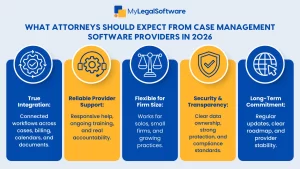
Many providers claim integration. Few deliver it. Real integration means your workflows connect seamlessly. Data moves between systems without manual transfers. Your calendar syncs with case deadlines. Billing connects to time tracking. Documents link to client matters automatically.
Integrated case management software should reduce friction, not create it. When systems work together, you spend less time on admin tasks and more time practicing law.
Shallow integrations look good in demos but fail in daily use. You click through multiple screens. You copy and paste between programs. You reconcile conflicting data. Real operational cohesion means the software anticipates what you need next.
How Provider Responsibility Is Expanding
Providers in 2026 must do more than sell dashboards. They share responsibility for your outcomes. When the system goes down, your practice stops. When updates break workflows, you lose billable hours.
Law firm case management software should come with clear accountability. The provider must support you during outages, updates, and scaling. They must respond quickly when problems arise.
Law firm management software isn’t just a tool you purchase. It’s the infrastructure your entire practice depends on. The provider relationship must reflect that reality. You need partners, not vendors.
Support, Training, and Responsiveness Are No Longer Optional
Support quality defines modern legal technology. Good support in 2026 means real people answer your questions. They understand legal workflows. They respond within hours, not days.
Training should continue past onboarding. As your practice grows, you need help with advanced features. When staff turnover happens, you need quick refresher sessions.
Law office case management software works only when your team knows how to use it. Poor support creates bottlenecks. Attorneys avoid features they don’t understand. The software becomes expensive shelfware.
Law office management software providers must invest in customer success. That means ongoing training, responsive help desks, and proactive check-ins. If your provider disappears after the sale, find a new one.
Adaptability for Different Practice Sizes and Practice Areas
Solo attorneys need different tools than 20-person firms. A personal injury practice has different workflows than a family law office. Your software should adapt to your specific needs.
Flexibility matters more than bloated feature lists. You want modular systems that grow with you. Start with basic case tracking. Add billing when you’re ready. Integrate document automation later.
Small law firm software should not force you into enterprise pricing or features you won’t use. Legal case management software that small firms can afford must scale affordably. You should never pay for tools you don’t need.
The best providers offer tiered options. They let you expand capabilities as your practice grows. They don’t lock essential features behind expensive upgrades.
Transparency, Security, and Long-Term Viability
You need clarity on data ownership. If you switch providers, can you export your files? Who owns the client records and case histories you’ve built?
Compliance matters. Your provider must maintain current security standards. They should explain their encryption, backup procedures, and breach response plans clearly.
Legal software programs must evolve. Ask about the product roadmap. How often do they release updates? Do they incorporate user feedback? Will they support the system five years from now?
Legal office software programs handle confidential client information. Provider transparency isn’t optional. You must know how they protect your data and plan for the future.
Open Source, Proprietary, or Hybrid
Law practice management software open source offers flexibility and control. You can customize extensively. You own the code. But you need technical expertise or budget for development help.
Proprietary systems provide easier implementation and ongoing support. You trade control for convenience. Hybrid solutions try to balance both approaches.
No option is universally better. The right choice depends on your practice size, technical comfort, and customization needs. Honest providers explain trade-offs clearly. They don’t oversell or hide limitations.
Provider honesty differentiates good partners from bad vendors. If they won’t discuss drawbacks openly, they’re not trustworthy long-term partners.
Choosing a Provider That Will Still Serve You in 2026 and Beyond
Software changes constantly. Providers should stay consistent. The company you choose today must remain responsive, innovative, and accountable years from now.
Evaluate providers on stability, support quality, and commitment to improvement. Look for companies that invest in customer success, not just customer acquisition.
MyLegalSoftware offers case management software for immigration attorneys and general practitioners. The platform supports cases from first contact through resolution. You can try it free for 14 days to see if it fits your practice.
Choose providers who treat you as partners. Your practice depends on their reliability. In 2026, that relationship matters more than any single feature.

Frequently Asked Questions
What should attorneys expect from a case management software provider in 2026?
Expect responsive support, ongoing training, transparent security practices, regular updates, and clear accountability when problems occur.
How is integrated case management software different from older legal systems?
True integration connects workflows seamlessly. Data flows between features automatically. You spend less time on manual data entry and system management.
Why does provider support matter as much as the software itself?
Without good support, even excellent software becomes unusable. When problems arise, you need fast, knowledgeable help to keep your practice running.
Is one legal case management system suitable for all firm sizes?
No. Solo attorneys, small firms, and large practices have different needs. Look for modular systems that scale with your growth.
How should attorneys evaluate long-term software providers?
Check customer reviews, ask about product roadmaps, test their support responsiveness, and verify their data security and backup procedures.
What role will integration play in future legal practice management?
Integration will become essential. Attorneys expect systems to work together seamlessly. Manual workarounds and disconnected tools waste time and create errors.