

You’re in a hearing. Opposing counsel mentions a date, and you know it’s wrong. You know you have documentation proving it, but you can’t immediately pull up your notes. You fumble through papers while you keep the judge waiting. That two-second hesitation shifts the entire tone of the courtroom.
This happens when you don’t have a structured case timeline ready. Even the strongest arguments become vulnerable when you can’t instantly access chronological facts.
Modern attorneys don’t rely on memory or scattered notes anymore. They use smarter tools that track every event consistently and make information instantly accessible when it matters most.
What a Case Timeline Really Is and Why It Matters
A case timeline is more than a chronological list of events. It’s a strategic tool that affects how clearly you understand your case, how accurately you present facts, and how effectively you prepare for litigation.
The difference between handwritten notes, spreadsheets, and professional legal timeline software is significant. Notes get lost. Spreadsheets become unwieldy with complex cases. Professional systems organize everything systematically, link events to evidence, and present information visually in ways judges and juries understand immediately.
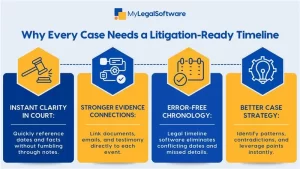
Why Every Attorney Needs a Reliable Timeline System
Cases are growing more complex, with multiple parties, hundreds of documents, and events stretching over years. Relying on memory or scattered files is no longer enough to keep everything accurate.
Deadlines stack up, filings demand precision, and evidence presentation depends on a clean chronology. A single date error can damage your credibility, and one missed link between events can weaken your entire narrative. The pressure never stops.
A structured legal timeline template brings consistency to every case, removing the chaos that comes from reinventing your system each time. It gives you a reliable framework that holds up under pressure and keeps your case strategy sharp and organized.
The Real Dangers of Handling Case Events Manually
Manual timeline tracking creates predictable problems. You miss deadlines because reminders live in your head instead of your system. Conflicting dates appear in your documents because you entered information inconsistently. Your narrative structure weakens because you can’t see the full picture clearly.
Confusion during trial prep costs you valuable time. You’re scrambling to verify dates rather than refine your arguments. Opposing counsel exploits errors that you didn’t catch because your manual system couldn’t flag inconsistencies automatically. These risks are entirely preventable with better systems.
What Makes a Strong, Litigation-Ready Case Timeline?
Strong timelines share specific characteristics. Clear chronological ordering shows the progression of events without confusion. Source-backed entries prove every date comes from verified documentation. Evidence-linked timestamps connect events to specific documents, photos, or testimony.
Highlighted inconsistencies reveal contradictions in opposing statements or witness accounts. Visual structure allows quick interpretation during hearings or trials. You can glance at your timeline and immediately understand what happened when.
These features define quality litigation timeline software. Technology handles organization automatically, so you focus on strategy instead of administrative details.
How Legal Technology Strengthens Your Timelines
Legal timeline software organizes events systematically. It tags entries by category, witness, or issue. It maintains perfect chronology even when you add events out of order. It links documents directly to timeline entries, so evidence is always one click away.
This reduces repetition. You enter information once, and it populates everywhere needed. Accuracy improves because the system catches duplicate or conflicting entries. Trial preparation speeds up dramatically because everything is already organized and accessible.
Using a standardized legal timeline template across all your cases creates consistency. Your team knows exactly where to find information. New cases start with a proven structure instead of blank documents.
Building a Timeline That Supports Your Case Strategy
Start by gathering every relevant date and source. Include obvious events like filings and hearings. Also include less obvious ones like phone calls, emails, and informal meetings that provide context.
Organize events using a clean template that maintains chronological order while allowing categorization by issue or party. Link evidence to each entry. Attach the email, the photo, and the document that proves this event happened exactly when you say it did.
Identify contradictions in opposing statements. When their timeline conflicts with yours, highlight it. These discrepancies become powerful tools during cross-examination and in your written arguments.
Use visual timelines to present arguments clearly. People process visual information faster than text. A well-designed timeline makes your narrative instantly understandable.
The Role of Timelines in Litigation and Negotiation
Timelines strengthen every phase of litigation. They improve deposition preparation by showing you exactly what questions to ask based on chronological inconsistencies. They reveal patterns in witness statements that might not be obvious from reading transcripts alone.
Better motions result from precise chronologies. When you cite specific dates backed by linked evidence, your arguments carry more weight. Negotiation leverage increases because you can demonstrate timeline facts that weaken the opposing position.
Litigation timeline software helps you show these patterns instantly. During hearings or settlement conferences, you pull up visual timelines that judges or opposing counsel can understand in seconds. This clarity often shifts outcomes in your favor.
Bring Clarity and Confidence to Every Case
Accurate, organized timelines aren’t optional for serious litigation. They’re fundamental to building strong cases and presenting them effectively. When your chronology is bulletproof, your arguments become more persuasive.
MyLegalSoftware (MyLS) provides comprehensive case management that supports timeline organization naturally. MyLS helps you track every event, upload related documents, and maintain clear chronological case histories. Timeline features integrate with broader case management workflows, so everything connects seamlessly.
The platform handles organization from the first client contact through final resolution. Your case timeline builds automatically as events happen and documents get uploaded.
Ready to experience better case organization? Try MyLS free for 14 days and see how integrated timeline management improves your litigation preparation and case outcomes.

Frequently Asked Questions
Why is a case timeline essential for litigation strategy?
Timelines organize facts chronologically, reveal inconsistencies in opposing narratives, support stronger arguments, and present complex information in ways judges and juries immediately understand.
What should be included in a strong legal timeline?
Every relevant date with source documentation, linked evidence for each entry, categorization by issue or party, and visual formatting that makes chronology instantly clear.
Is legal timeline software better than tracking dates manually?
Yes. Software prevents errors, links evidence automatically, maintains perfect chronology, flags inconsistencies, and presents information visually in ways manual tracking cannot match.
How does a legal timeline template help standardize case preparation?
Templates provide consistent structure across all cases, reduce setup time, ensure nothing gets missed, and create organizational consistency that helps teams work more efficiently.