You need the final version of a client contract. You know it exists. But which folder? Which email thread? Which person’s computer? Ten minutes turn into 30. The client is waiting. Your stress builds. When you finally locate it, you discover it’s not the final version after all. Someone made changes you didn’t know about.
This scenario costs more than time. It costs credibility when clients question your organization. It costs peace of mind when you’re never quite certain you have the right version. It costs money when version confusion leads to disputes about what was agreed.
This is why attorneys are shifting to cloud-based contract management, whether they realize they’re making that shift or not. Every time you use a shared document instead of email attachments, you’re moving toward cloud workflows.
The question isn’t whether to adopt these systems. It’s a choice between doing it intentionally with proper infrastructure or continuing to piece together inadequate solutions.
Why Contract Chaos Is a Modern Legal Risk
Contracts aren’t static documents anymore. They’re living negotiations involving multiple parties across different locations. Revision speed has accelerated. Client expectations for responsiveness have increased. Contract volume has grown as legal work becomes more transaction-heavy.
Traditional storage and tracking models quietly fail attorneys under these conditions. Email attachments create version chaos. Desktop folders disappear when computers fail. Shared network drives lack proper access controls. These legacy approaches weren’t designed for how legal work happens now.
The failure isn’t dramatic. It’s incremental. Small inefficiencies compound into serious operational problems. Cloud-based contract management addresses these systemic issues through centralized access, automatic version control, and systematic organization that doesn’t depend on individual memory or filing habits.
What Cloud-Based Contract Management Actually Changes for You
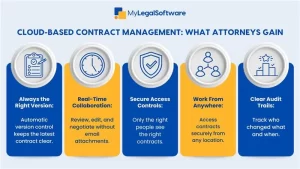
Move beyond abstract definitions. Focus on practical impact. Version control means you always know which draft is current. Multiple people can review simultaneously without creating conflicting copies. Access means working from anywhere without emailing files to yourself. Collaboration means negotiating with opposing counsel or clients without endless attachment exchanges.
Accountability improves because systems track who changed what when. This protects you during disputes about contract terms. Documentation proves exactly what happened without relying on memory or reconstructing events from scattered emails.
You regain control instead of adding another tool to manage. Cloud-based contract management centralizes what was scattered. It organizes what was chaotic. It provides certainty where there was confusion.
Control Without Compromise: Security, Access, and Oversight
Common attorney concerns about cloud systems deserve direct answers. Security matters enormously when handling client contracts containing sensitive business information, financial details, and strategic plans.
Who can access what, when, and why get determined by permissions you control. Not everyone sees everything. Clients access only their contracts. Associates see matters they’re working on. Partners maintain oversight across the practice.
Cloud contract management systems enforce these access rules systematically instead of relying on manual security practices that fail under pressure.
Oversight improves rather than diminishes. Audit trails show exactly who accessed which contracts and when. You can prove proper handling during malpractice claims or client disputes. This documentation protects you more than filing cabinets ever could.
How Cloud-Based Contract Management Supports Real Legal Workflows
Consider your actual contract workflow. Drafting. Review. Negotiation. Execution. Storage. Each stage involves multiple people and numerous revisions. Traditional methods create friction at every transition.
Cloud-based contract management removes that friction. Drafting happens in shared environments where team members collaborate in real time. Review involves commenting directly on documents instead of emailing marked-up copies.
Negotiation with opposing counsel uses secure sharing instead of attachment exchanges. Execution connects to e-signature tools. Storage is automatic because everything stayed in one system throughout.
You save time without sacrificing judgment. The system handles version control, access management, and organization. You handle legal analysis, strategy, and client counsel. This division of labor lets you focus on work requiring actual attorney expertise.
Client Expectations Are Changing
Clients expect speed. Speed means they don’t wait days for simple contract access. They expect clarity about contract status and next steps. They expect professionalism demonstrated through organized, accessible systems.
Contracts are part of client experience now. Clients notice when you can’t instantly locate documents. They appreciate when contract review happens quickly because your systems support efficiency. They value transparency when they can see contract status through client portals.
Cloud-based contract management reduces friction in client relationships. Fewer delays. Less confusion. Better communication. These improvements come from infrastructure supporting modern client expectations instead of fighting them.
When Cloud Systems Become Competitive Advantage
Firms using better systems feel calmer, not busier. They handle more contracts without proportional stress increases. They delegate confidently because systems maintain quality regardless of who’s working on what. They make fewer errors because automation handles details humans forget.
This isn’t about working faster. It’s about working sustainably. Reduced risk from better version control and access management. Better delegation is enabled by role-based permissions. Fewer errors through systematic organization. These benefits compound into practices that grow without breaking.
Cloud-based contract management represents how legal work functions going forward. Early adoption means learning systems before pressure forces rushed implementation.
Contracts Should Work for You, Not Against You
Contract work shouldn’t create constant stress about versions, access, and organization. When your infrastructure handles these mechanical concerns systematically, you focus on substantive legal work. An attorney’s well-being, clarity, and control improve through systems supporting rather than complicating your work.
MyLegalSoftware helps immigration attorneys and general practitioners manage all aspects of legal work, including contracts from first client contact through case resolution. The platform provides centralized access, systematic organization, and proper security for sensitive client information.
Ready to experience how modern infrastructure reduces contract-related stress? MyLS offers a 14-day free trial. Evaluate whether cloud-based systems really do improve control, reduce risk, and support better legal work without pressure or sales tactics.

Frequently Asked Questions
What makes cloud-based contract management different from traditional contract storage?
Active version control, real-time collaboration, systematic access permissions, automatic organization, and anywhere-access instead of static file storage requiring manual version tracking and physical presence.
Is cloud-based contract management secure enough for sensitive legal documents?
Yes, when choosing reputable legal-specific providers. Look for encryption, role-based access controls, audit trails, secure sharing capabilities, and compliance with legal industry security standards.
How does cloud-based contract management help reduce contract disputes?
Version history documenting every change, audit trails showing who accessed what and when, and centralized storage preventing “different version” arguments that arise from scattered file storage.
Can cloud-based contract management fit both solo and growing law firms?
Yes. Systems scale from individual practitioners to large teams without requiring different infrastructure. Solo attorneys gain an enterprise-level organization. Growing firms avoid outgrowing their systems.
What should attorneys look for when adopting contract management tools?
Legal-specific features, intuitive interfaces, reliable security, proper access controls, integration with existing workflows, responsive support, and transparent pricing without hidden costs.
How does contract management integrate into broader legal workflows?
Quality systems connect contracts with case files, client communications, matter timelines, and billing, so contract work flows naturally with other legal practice activities.