

The last client call ends. The brief is filed. The work is done. And then comes the part no one went to law school for: reconstructing hours from memory, hunting through notes, and hoping nothing billable slipped through the cracks while turning a week of legal work into a law firm invoice that will survive client scrutiny.
This is where small firms quietly give up ground, not in the courtroom or at the negotiating table, but behind the scenes. Outdated invoicing systems drain time, invite errors, and slow payment, all while larger firms hum along with automated tools built to protect revenue. In a profession where time is money, smarter invoicing isn’t to be treated as an afterthought. It is one of the few places small law firms can outmaneuver bigger rivals.
Why Invoicing Is a Competitive Tool, Not Just an Admin Task
For many attorneys, invoicing still feels like an administrative chore that must be endured at the end of the month. In reality, billing is one of the clearest signals a firm sends to its clients about competence and credibility. A confusing or inconsistent legal invoice raises doubts, even when the legal work itself is solid.
Large firms invest heavily in systems that ensure billing is timely, standardized, and precise. Small firms often rely on memory, spreadsheets, or static law office invoice templates. The result is predictable. Invoices go out late, billable time gets lost, and clients ask more questions than they should.
Smarter invoicing tools shift this dynamic by embedding billing into daily workflows. Time tracking, expenses, and case activity are captured as work happens, not reconstructed later. This protects revenue and presents clients with invoices that are clear, consistent, and easier to trust.
The Hidden Cost of Manual Billing
Manual billing does not just waste time. It quietly drains revenue. When attorneys delay entering time, small increments disappear. When invoices are rushed, errors creep in. When billing feels painful, it gets postponed, which slows cash flow.
Over a year, these small losses add up to a meaningful competitive gap.
How Smarter Invoicing Helps Small Firms Punch Above Their Weight
Smarter invoicing tools are not about flashy features. They are about removing friction from a process that should be routine but rarely is.
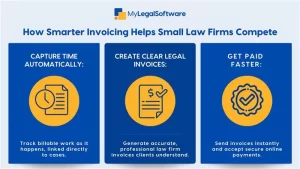
Turning Time into Revenue Without the Guesswork
Modern invoicing software captures billable activity in real time and ties it directly to cases and clients. Attorneys no longer need to remember how long a call lasted or which matter a task belonged to. The system already knows.
This leads to more complete billing and fewer uncomfortable conversations with clients about revised invoices or missing details. For a small firm, consistency like this builds confidence and professionalism that rivals much larger practices.
Presenting a Clear, Professional Legal Invoice
Clients do not expect simplicity from the law, but they do expect clarity from their bills. Smarter invoicing tools allow firms to generate legal invoices that are easy to read, properly itemized, and consistent from month to month.
When clients understand what they are paying for, disputes decline and payment cycles shorten. That alone can change the financial rhythm of a small firm.
Competing On Efficiency Instead of Headcount
Large firms compete with size. Small firms compete with efficiency. Smarter invoicing tools help tilt the balance.
Integrated systems link time tracking, case management, and billing into a single workflow. There is no need to reconcile multiple tools or chase down missing information. Attorneys spend less time fixing invoices and more time doing billable work.
Just as important, firm leaders gain visibility into outstanding invoices, payment trends, and revenue by case. This kind of financial insight used to require dedicated accounting staff. Now it is available with a few clicks.
Making Adoption Practical, Not Disruptive
The idea of changing billing systems can feel daunting, especially for busy firms. In practice, adoption works best when it is gradual and grounded in real use.
Start by identifying where billing currently breaks down. Choose invoicing software designed specifically for law firms. Roll it out in stages, using actual cases during training so staff see immediate value. The goal is not perfection on day one, but steady improvement.
Why Smarter Invoicing Is No Longer Optional
The legal market is not getting simpler, and clients are not getting more patient. Small law firms that cling to manual billing are choosing friction over focus. Smarter invoicing tools offer a different path, one that saves time, reduces errors, and stabilizes cash flow.
More than anything, they allow attorneys to spend their energy where it belongs, on legal work rather than administrative cleanup.
If your firm is ready to compete with confidence instead of chaos, it may be time to rethink how you invoice.
Schedule a free demo with MyLegalSoftware.com to see how smarter invoicing tools can help your firm bill efficiently, get paid faster, and compete at a higher level.
Frequently Asked Questions
- What is legal invoicing software for small law firms?
Legal invoicing software helps small law firms track time, generate accurate legal invoices, and manage billing in one system designed specifically for legal workflows.
- How does smarter invoicing help small law firms compete?
Smarter invoicing reduces billing errors, captures more billable hours, and speeds up payments, allowing small firms to operate more efficiently like larger practices.
- What should a professional law firm invoice include?
A professional law firm invoice should include clear time entries, detailed descriptions of services, billing rates, expenses, and consistent formatting clients can easily understand.
- Is invoicing software better than using spreadsheets or templates?
Yes. Invoicing software automates time tracking and billing, which reduces missed revenue and saves time compared to manual spreadsheets or static law office invoice templates.
- How long does it take to implement invoicing software in a small firm?
Most small law firms can begin using invoicing software within days, especially when tools are cloud-based and designed for simple onboarding and gradual adoption.