

It is Friday afternoon. You have three I-485 filings scheduled for next week, two RFE responses due, and a client whose employment authorization expires in 11 days. Your paralegal is out sick, and you are trying to prioritize which cases need immediate attention when you realize the deadline you thought was next Tuesday is actually Monday.
Immigration law leaves zero margin for operational error. One missed filing deadline can derail a client’s entire future, one disorganized document set can trigger an RFE that adds months to a case, and one forgotten follow-up can keep a family separated longer than necessary.
Today, immigration software for attorneys has shifted from a helpful tool to mission-critical infrastructure. This is no longer about convenience. It is about whether your practice can handle the volume, scrutiny, and documentation requirements that modern immigration work demands. This blog covers the must-haves.
Why Immigration Practices Need Specialized Software in 2026
Generic legal tools fail immigration workflows consistently. They don’t understand USCIS forms. They can’t calculate visa priority dates. They lack built-in immigration deadline rules. They treat every case type the same when family-based applications, employment visas, and removal defense each require different workflows.
Volume, scrutiny, and documentation requirements keep increasing. USCIS processes more forms with stricter evidence standards. Backlogs extend timelines unpredictably. Policy changes require rapid workflow adjustments. You need immigration law software designed specifically for these challenges, not generic tools trying to fit every practice area.
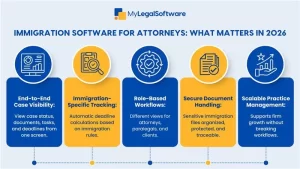
Looking forward, firms that treat software as infrastructure instead of expense will handle 2026 demands better than firms still fighting inadequate systems.
-
End-to-End Case Visibility
Immigration cases break when data lives in silos. Client information in one system. Documents in another. Deadlines tracked separately. Communications scattered across email. Nobody can see the complete case status without checking multiple places and asking multiple people.
Real visibility means attorneys see everything about a case from one screen. Current status. Pending tasks. Recent communications. Uploaded documents. Approaching deadlines. All connected without jumping between platforms. Immigration software for lawyers must provide this centralization, or it’s not solving the core problem.
Immigration software programs that fragment information create more work than they eliminate. Choose systems emphasizing control through clarity, not complexity through scattered features.
-
Built-In Immigration Tracking That Prevents Deadline Drift
Deadlines quietly slip in high-volume practices. You mentally track cases until volume exceeds memory. Then you rely on calendar reminders you manually set. Then you miss one because you were overwhelmed when the reminder fired. This pattern repeats constantly in busy immigration practices.
Manual tracking fails in 2026 because volume has grown beyond what human memory and calendars can reliably handle. You need immigration tracking software that understands immigration-specific deadlines automatically. Systems that calculate based on receipt dates, priority dates, and filing requirements, without you manually entering each one.
Tracking directly affects attorneys’ peace of mind. When you trust your system to flag approaching deadlines, you stop mentally carrying every date. That mental relief matters more than most attorneys realize until they experience it.
-
Role-Based Workflows for Attorneys and Paralegals
One-size-fits-all dashboards don’t work. Attorneys need case strategy visibility. Paralegals need task lists and document checklists. Clients need status updates and document upload access. Showing everyone the same interface confuses rather than clarifies.
Role clarity improves both speed and accuracy. When immigration software for paralegals shows exactly what they need to complete without overwhelming them with attorney-level strategy decisions, they work more efficiently. When attorneys see strategic priorities without administrative clutter, they make better decisions.
Immigration management software should support your team structure instead of fighting it. Role-based design isn’t about restricting access. It’s about showing each person what matters most for their work.
-
Secure Document and Data Handling Built for Immigration Law
Immigration documents are both voluminous and highly sensitive. Passports. Birth certificates. Financial records. Medical examinations. Employment letters. Each case generates hundreds of pages requiring organization and protection.
Storage alone isn’t enough. You need version control. Naming conventions that make files findable. Access permissions protecting sensitive information. Audit trails showing who accessed what when. Immigration legal software must treat documents as critical case components, not afterthought storage.
This builds trust, ensures compliance, and gives you confidence that sensitive client information stays protected while remaining accessible to appropriate team members.
-
Practice Management That Supports Growth, Not Burnout
What happens when your caseload doubles? Manual coordination that barely worked becomes completely impossible. Switching software mid-growth disrupts operations when you can least afford disruption.
Immigration practice management software should scale naturally. Handling more cases without requiring different systems or extensive reconfiguration. Supporting additional attorneys and paralegals without breaking workflows. Modern firms need systems that think ahead instead of forcing replacement for every growth phase.
Immigration lawyer software that scales properly prevents the burnout that comes from fighting inadequate infrastructure while trying to serve more clients.
Choosing Immigration Software That’s Ready for 2026
Software decisions you make now define firm stability later. Technology isn’t an optional expense anymore. Its infrastructure determining whether your practice can handle increasing complexity and volume demands that immigration law creates.
The right system reduces operational friction so you focus on legal work. It prevents the deadline disasters that damage reputations. It scales with growth instead of limiting it. It supports both attorneys and team members with role-appropriate interfaces.
MyLegalSoftware is built specifically for immigration attorneys managing complex caseloads from first client contact through final case resolution. The platform handles immigration-specific workflows, tracking, and documentation requirements that generic legal software misses.
Ready to see whether your current systems actually support 2026 demands? ImmigrationQuestion.com offers a 14-day free trial. Test it with active cases and experience whether proper immigration-specific infrastructure really does reduce stress and improve outcomes.

Frequently Asked Questions
What makes immigration software different from general legal software?
Immigration-specific systems understand USCIS forms, calculate immigration deadlines automatically, organize cases by visa category, and include workflows designed around immigration practice patterns that general software lacks completely.
How does immigration tracking software reduce compliance risks?
Automated deadline calculations based on immigration-specific rules, systematic reminder systems, and audit trails documenting every action protect against missed filings and forgotten obligations.
Should paralegals use the same system as attorneys?
Yes, but with role-appropriate interfaces. Paralegals need task-focused views while attorneys need strategic oversight. Same system, different appropriate access and visualization.
Can immigration practice management software scale with firm growth?
Quality systems handle increasing caseloads, additional staff, and practice expansion without requiring replacement or extensive reconfiguration as your firm grows.