
In today’s digital-first legal environment, law firm information security is no longer optional; it’s foundational. Law firms handle massive volumes of highly sensitive data, from personal identifiers to confidential case strategies.
As cybercriminals become more sophisticated, law firms have become prime targets for ransomware, phishing, and data breaches. In fact, attackers may think of law firms as one-stop data hubs with minimal defenses.
A single breach can lead to regulatory penalties, lawsuits, and irreversible damage to your firm’s reputation. That’s why developing and maintaining a law firm information security policy is critical. In this guide, we’ll break down exactly why information security matters for legal practices, what threats to watch out for, and how to build a secure, compliant, and client-trusted law firm in 2025.
Why Law Firm Information Security Is Non-Negotiable
Law firms have a legal and ethical duty to protect their clients, and that begins with protecting their data. Here are the key reasons why information security is mission-critical for law practices in 2025.
1. Sensitive Legal Data Makes Firms High-Value Targets
Attorneys manage deeply sensitive client records, from financial statements and medical reports to witness interviews and litigation strategies. The nature of legal work means law firms often store personally identifiable information (PII), privileged communications, and even evidence for ongoing criminal or civil cases. This makes law firm networks especially attractive to hackers looking to exploit valuable data with minimal technical barriers.
2. Legal Ethics and Compliance Obligations
Across jurisdictions, professional rules and regulations require law firms to implement reasonable safeguards. The ABA Model Rules of Professional Conduct, particularly Rule 1.6(c), mandates attorneys to take proactive steps to prevent unauthorized data disclosure. Global firms must also comply with GDPR, HIPAA, and other data privacy laws. Failure to comply jeopardizes client trust and risks sanctions and civil liability.
3. Damaged Reputation and Loss of Clients
A data breach at a law firm can lead to a public relations disaster. Clients always expect confidentiality, and any breach undermines that trust. News of a cybersecurity lapse can quickly spread through media or legal networks, leading to lost clients, negative reviews, and long-term brand damage that’s difficult and expensive to repair.
4. Costly Lawsuits and Financial Losses
When law firms experience a breach, the financial toll can be significant. Beyond system recovery costs, firms may face class action lawsuits and fines. Protecting your systems upfront is far more affordable than paying for a breach after it happens.
5. Remote Work Has Increased Attack Surfaces
The shift to remote and hybrid work environments has expanded potential vulnerabilities. Attorneys now log in from home networks, personal devices, and shared workspaces. Without a robust law firm information security policy, firms face greater risks from unsecured Wi-Fi, poor password practices, and unsanctioned file sharing.
Top Threats Facing Law Firms Today
Before you can secure your firm, you need to know what you’re up against. Here are the five biggest cybersecurity threats law firms face today.
1. Phishing and Social Engineering Attacks
Cybercriminals frequently use phishing emails to trick staff into revealing passwords or downloading malware. These messages often mimic trusted contacts, like clients or opposing counsel, and bypass basic spam filters. Social engineering preys on human error. So, employee training and awareness are vital for defending against this threat in a law firm.
2. Ransomware That Locks Firms Out of Their Own Files
Ransomware attacks encrypt your firm’s files, demanding a ransom for their return. Law firms, which depend on constant data access, are particularly vulnerable. Some attackers threaten to leak confidential data unless paid. Prevention relies on strong endpoint security, offline backups, and clear breach response protocols.
3. Insider Threats
Not all breaches come from outsiders. Employees, through negligence or ill intent, can expose client data. An attorney might accidentally forward sensitive files to the wrong recipient. Worse, a paralegal could sell data to third parties. Information security for law firms must include access controls and audit trails to mitigate this risk.
4. Weak Access Controls and Unsecured Devices
When everyone in a law firm can access everything, one compromised password can expose the entire system. Without proper access segmentation and device management policies, even junior staff or interns might unintentionally jeopardize sensitive data. Enforce role-based access control and device encryption for all firm-owned and personal equipment.
5. Remote Work Without Secure Infrastructure
Remote access is quickly becoming the norm in law practice, but often without enterprise-level security tools. Lawyers using unsecured home networks, outdated software, or public Wi-Fi put your entire firm at risk. To stay secure, firms must implement virtual private networks (VPNs), endpoint monitoring, and remote access rules tailored for legal professionals.
Creating a Law Firm Information Security Policy That Works
A well-designed law firm information security policy is not just a document; it’s a framework that protects your firm from both internal and external threats. It defines expectations, enforces accountability, and ensures that your tools, people, and processes are aligned with best practices. Here are the key components to include:
1. Clear Definitions and Rules
A strong information security policy outlines the roles, rules, and responsibilities for managing sensitive data. It should clearly define what data is considered confidential, who can access it, how it’s stored, and under what conditions it can be shared. This policy also serves as a reference during audits, breaches, or compliance checks.
2. Role-Based Access Control (RBAC)
Role-based access ensures that employees only have access to the data necessary for their job function. This minimizes the risk of unauthorized exposure, intentional misuse, or accidental leaks. Implementing RBAC also helps streamline auditing, supports the principle of least privilege, and reduces the attack surface in hybrid and remote setups.
3. Data Encryption Standards
Encryption is non-negotiable in 2025. Your firm must use advanced encryption protocols for data both in transit and at rest. This protects emails, documents, and communications from being intercepted or exposed, especially when transmitting PII, case files, or billing information to clients or courts.
4. Bring Your Own Device (BYOD) and Remote Work Security Rules
Firms must set strict policies for employee-owned devices and remote access. Use mobile device management (MDM), enforce password complexity, mandate VPN use, and prohibit storage of client files on personal cloud accounts. Remote work isn’t going away, so your policy should reflect a security-first approach to flexibility.
5. Routine Audits and Policy Updates
Annual or biannual audits should assess technical safeguards, policy compliance, and evolving threats. Your information security policy should be updated accordingly, with clear version control and change logs. Keep staff informed with mandatory training sessions so everyone understands new rules and how to implement them in daily practice.
Essential Law Firm Technology Solutions for Information Security
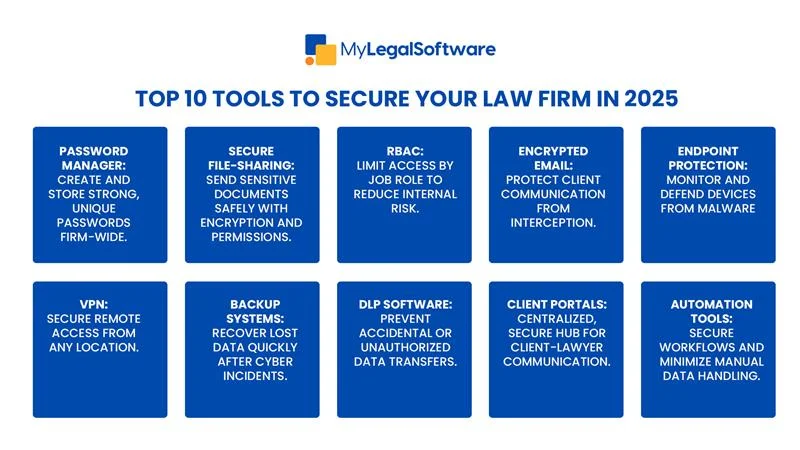
Modern law firms can’t afford to rely on outdated systems. You need tools built specifically for legal work with a solid security system. Here are ten essential technologies that can strengthen your law firm’s information security:
1. Secure File-Sharing Platforms
Certain tools allow encrypted file exchange with clients and co-counsel. Unlike email attachments, these platforms include audit trails, granular permissions, and expiration settings. They prevent data leaks while maintaining ease of collaboration across different parties.
2. Password Managers
Weak or reused passwords are still one of the biggest vulnerabilities in law firm information security. Password managers help staff create and store strong, unique passwords securely. They can also alert you when a password has been compromised.
3. Two-Factor Authentication (2FA)
2FA adds an extra layer of protection beyond passwords. Whether via SMS, authenticator app, or biometric prompt, it blocks unauthorized access even if credentials are compromised. Firms should enforce 2FA across email, case management, cloud storage, and internal portals.
4. Endpoint Protection Platforms
Modern endpoint protection goes beyond scanning for viruses. Some systems detect real-time threats using AI, isolate infected systems, and alert administrators. As remote work rises, endpoint security ensures that every device accessing the firm’s data is continuously monitored.
5. Encrypted Email Providers
Law firms often communicate highly sensitive data via email. Email encryption ensures that only intended recipients can read the content. Encryption is especially vital when sharing medical records, financial data, or confidential case updates.
6. Legal Automation Tools with Built-In Security
Case management systems that incorporate automated case management features, including built-in encryption, audit logs, and access controls, are necessary. Automating workflows reduces human error, enforces compliance, and protects data by limiting manual input and data duplication across platforms.
7. Virtual Private Networks (VPNs)
VPNs create a secure tunnel between a user’s device and the firm’s network. This prevents hackers from intercepting data on public or home Wi-Fi. VPNs should be mandatory for all remote staff, contractors, and third-party collaborators accessing firm systems.
8. Backup and Recovery Systems
If your firm gets hit with ransomware or suffers a server crash, cloud-based backups can be a lifesaver. Use platforms that offer geo-redundancy, encryption, and versioning to restore data quickly.
9. DLP (Data Loss Prevention) Software
DLP tools monitor outgoing data and flag or block unauthorized transfers. Whether someone tries to upload client files to Dropbox or email confidential information outside the firm, DLP helps prevent intentional leaks and accidents that compromise trust and compliance.
10. Secure Client Portals
Secure portals give clients a centralized place to view case updates, exchange documents, and message attorneys. They reduce reliance on insecure channels like email or SMS. Modern client portals often include 2FA, activity logs, and message encryption by default.
Final Thoughts: Taking Action on Law Firm Information Security
As law firms continue to digitize operations, information security is no longer optional; it’s a business-critical priority. The risks are high, and the legal industry’s sensitive data makes it a top target.
To stay protected, firms must assess current vulnerabilities, implement secure technologies, create a clear law firm information security policy, and invest in staff training. Start with essentials like encrypted file-sharing, strong password policies, and legal-focused case management platforms.
Platforms like MyLegalSoftware offer a secure solution for legal teams managing sensitive data. With built-in compliance features and strong access controls, it’s a smart choice for law firms prioritizing security. Try it free for 14 days and experience how the right tools can protect your practice and your clients.
Frequently Asked Questions
-
What is law firm information security, and why does it matter?
-
How can law firms protect sensitive client data from cyberattacks?
-
What should be included in a law firm’s information security policy?
-
How do legal automation tools improve law firm security?
Law firm information security refers to protecting sensitive legal data, like client files, case strategies, financial records, etc., from unauthorized access, theft, or loss. It matters because law firms handle high-value confidential information that makes them prime cyberattack targets.
Firms can protect data through encryption, strong access controls, employee training, endpoint protection, secure communication tools, and by adopting a comprehensive information security policy that’s regularly updated.
Your policy should cover role-based access, password standards, remote work protocols, data encryption practices, software updates, incident response plans, and audit schedules to ensure ongoing compliance and security.
Modern legal automation tools often come with built-in security features like encryption, permission controls, and audit trails. They reduce manual errors and ensure consistent application of security protocols across workflows.