

You finish a case, send a quick update to your client, and then… the invoice sits unfinished. Someone forgot a time entry, a line item looks unclear, or a small mistake makes you hesitate to send it. It is a situation most law offices are familiar with.
Invoices are more than just numbers on a page. They show clients how professional, organized, and reliable your firm really is. Clients notice the details, compare bills, and judge whether your firm runs smoothly. The question is simple: is your invoicing helping your firm get paid on time, or is it perhaps quietly holding you back?
Why Law Office Invoices Matter More Than Ever in 2026
The modern legal invoice sits at the intersection of trust, transparency, and revenue. Clients want to know what they are paying for, when the work was done, and why it took the time it did. Law firms, meanwhile, want to ensure that every legitimate hour is captured, billed, and paid without friction.
What has changed is not the need to bill, but the tolerance for inefficiency. Delayed invoices signal disorganization. Inconsistent descriptions invite questions. Manual corrections suggest uncertainty. In 2026, these signals cost more than time. They cost confidence.
A well-prepared law firm invoice does quiet but important work. It reassures clients that their matter is being handled with care. It gives billing staff fewer fires to put out. And it allows attorneys to focus on practicing law rather than defending line items.
The Hidden Cost of Outdated Billing Habits
Many firms still rely on habits formed years ago, when billing cycles were slower and client scrutiny was lighter. Time is entered days after the fact. Invoices are assembled manually. Formatting varies by attorney. None of this feels dramatic in isolation, but together it adds up.
Lost time entries reduce revenue. Vague descriptions trigger follow-up emails. Corrections delay payment. Over time, these small frictions turn the law office invoice into a recurring source of stress rather than a predictable close to completed work.
The problem is not a lack of effort. It is a lack of systems designed for how law firms actually operate today.
What Law Office Invoice Best Practices Look Like Now
Clear Narratives, Not Cryptic Line Items
Best practices in 2026 favor clarity over shorthand. Clients do not need legal strategy spelled out, but they do need context. A legal invoice should read as a concise narrative of progress, not a list of unexplained fragments.
This means time descriptions that explain purpose, consistency in how tasks are labeled, and enough detail to answer the reasonable question, “What moved my case forward here?”
Consistency Across the Firm
A law firm invoice should not feel like it was drafted by five different offices using five different styles. Consistent formatting, terminology, and structure reduce confusion and build trust. They also make internal review faster and easier.
Consistency is not about rigidity. It is about predictability.
Why Legal Software Has Become Central to Billing Best Practices
The shift toward smarter invoicing did not happen because firms wanted new technology for its own sake. It happened because billing had outgrown manual tools.
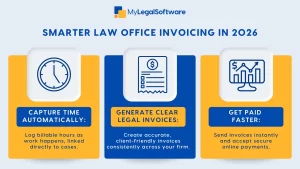
Modern legal software connects time tracking, case management, and invoicing into a single workflow. When time is captured as work happens and tied directly to matters, invoices become a natural outcome rather than a reconstruction exercise.
With platforms like MyLegalSoftware, the law office invoice is generated from real activity, not memory. Errors decrease. Delays shrink. Payment timelines improve. The result is not just efficiency, but a calmer billing culture.
From Time Entry to Payment Without the Detours
Integrated systems reduce the handoffs that cause problems. Attorneys log time within their cases. Billing teams review entries in context. Invoices go out promptly and accurately. Clients receive clear bills and easy payment options.
Each step supports the next, and none relies on guesswork.
Adopting Better Invoicing Without Disrupting the Firm
Change is often resisted not because it is unwelcome, but because it feels disruptive. Successful firms approach invoicing upgrades deliberately.
They start by agreeing on billing standards. They train attorneys and staff together, emphasizing why consistency matters. They roll out new tools in stages, allowing time to adjust. Most importantly, they review early results and refine processes before problems take root.
The firms that thrive in 2026 are not the ones with the most features, but the ones with the clearest workflows.
The Law Office Invoice as a Client Relationship Tool
It is easy to think of invoicing as purely transactional, but clients see it differently. An invoice is often the most regular communication they receive. It reinforces impressions, for better or worse.
Clear, timely legal invoices signal respect for the client’s time and money. They reduce awkward conversations and strengthen long-term relationships. In that sense, invoicing is not separate from client service. It is part of it.
Looking Ahead and Taking the Next Step
Law office invoice best practices in 2026 are less about billing harder and more about billing smarter. Firms that embrace clarity, consistency, and integrated systems protect revenue while improving daily operations.
The tools now exist to make invoicing predictable, professional, and low stress. The question is whether your firm is ready to use them.
Schedule a free demo to see how MyLegalSoftware can help your firm bring its invoicing practices into 2026 with confidence and control.

Frequently Asked Questions
What should a law office invoice include in 2026?
A law office invoice should include clear time descriptions, consistent formatting, accurate totals, and enough detail for clients to understand the value of the work performed.
How can law firms reduce billing disputes with clients?
Law firms reduce disputes by sending timely legal invoices, using clear task descriptions, and standardizing billing practices across all attorneys.
Why do law firms use legal billing software instead of spreadsheets?
Legal billing software improves accuracy, captures time automatically, reduces errors, and helps firms generate professional invoices faster than manual methods.
How does better invoicing improve law firm cash flow?
Clear and timely law firm invoices lead to faster payments, fewer write-offs, and more predictable revenue.
Is legal invoicing software worth it for small law firms?
Yes. Even small firms benefit from automated time tracking, consistent invoices, and reduced administrative work, which saves time and protects billable revenue.