
You’ve finally expanded, a new office, a new state, maybe even a new country. Excitement fills the air until your legal tech shows its limits. The system that once made your life easier suddenly refuses to recognize a new filing format. Deadlines don’t sync properly, and compliance alerts go silent.
Now your team is juggling spreadsheets, duplicating systems, and engaging in late-night troubleshooting. What changed? The answer is simple: your firm outgrew its technology.
So how do you make sure your tools evolve with your practice, not against it?
That’s the main point of legal tech cross-jurisdiction management:, understanding how technology either supports or stalls your firm’s ability to work across regions. When systems can’t handle multiple jurisdictions, even the most capable teams lose momentum.
But when your tech adapts to each jurisdiction seamlessly, you eliminate friction, reduce risk, and keep your focus where it belongs: on clients.
The good news is that the right approach and the right tools can turn those growing pains into a blueprint for expansion.
The Complexity of Practicing Across Borders
Running a multi-location firm isn’t just about managing different offices. It’s about navigating the fine print of every jurisdiction you serve. Filing requirements vary, as data privacy laws change. Even document formats and submission protocols differ.
That’s where multi-jurisdiction legal software becomes invaluable. Instead of forcing your attorneys to toggle between systems or memorize local rules, the right software brings it all together. It unifies your case files, communication logs, and deadlines under one secure platform, tailored for every region you work in.
Think about how smoother your operations become when your team doesn’t waste time converting forms or double-checking region-specific filing codes. Automation handles the heavy lifting. Standardization keeps your processes consistent. And every team member, from junior associate to partner, stays aligned with what needs to be done, no matter the jurisdiction.
The real challenge isn’t just legal complexity; it’s human confusion. Switching between systems drains time and morale. With a unified cross-jurisdiction setup, your staff spends less time adjusting and more time performing.
Why Compliance Can Make or Break Multi-Jurisdiction Practice
Ask any attorney who’s worked across borders; compliance can be both your firm’s greatest strength and its biggest vulnerability. One missed jurisdictional rule, one outdated form, and suddenly your reputation is at risk.
That’s why legal compliance across jurisdictions isn’t just another technical box to check; it’s the backbone of long-term sustainability. Each region comes with its own data security laws, client confidentiality rules, and filing standards. Keeping up manually is nearly impossible.
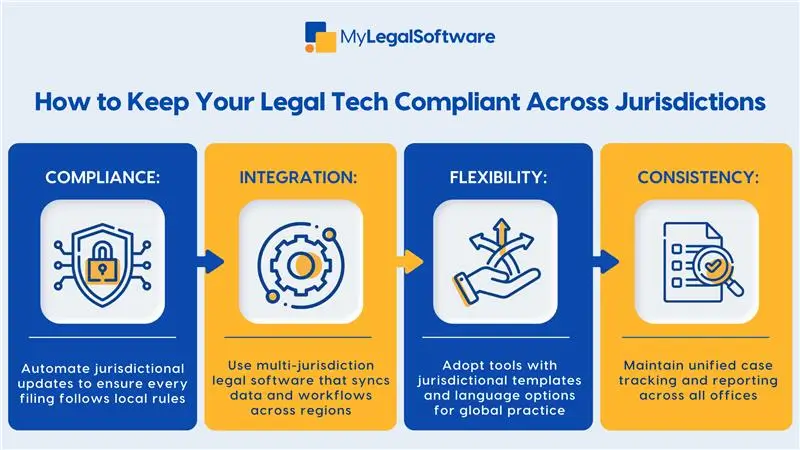
The smart move is to automate compliance wherever possible. Choose platforms that update their jurisdictional templates in real time, track changes to local regulations, and generate alerts when new compliance requirements are introduced.
A few practical steps to keep your practice safe:
- Use built-in jurisdiction templates. They save you from formatting or filing errors that differ by region.
- Automate compliance tracking. When laws change, your system should adapt automatically.
- Keep region-specific audit trails. This protects your firm if questions ever arise about your processes.
Compliance isn’t just paperwork; it’s protection. It keeps your firm credible, your clients secure, and your operations steady, even as you expand.
Technology That Keeps Up with Global Practice
Law is becoming increasingly borderless. You might be based in California but might be handling clients in Toronto, or even running an immigration case that spans multiple continents. Without the right tech, managing all those moving parts can be overwhelming.
That’s why cross-border law firm tools are changing how modern firms operate. They allow you to coordinate filings, track communication, and manage deadlines, all within one ecosystem that understands jurisdictional nuances.
With these tools, your team doesn’t have to jump between regional databases or separate dashboards. Everything syncs automatically. Case files remain accurate, client notes are consistent, and every document follows the correct regional protocol.
For distributed teams, this consistency means everything. Whether your associate is in New York or London, everyone is working off the same case data in real time. It’s not just about convenience, it’s about control, compliance, and confidence.
Software That’s Designed for Flexibility
The best legal technology doesn’t just follow rules; it understands them. Every jurisdiction has its own unique structure, from filing systems to compliance updates. A truly flexible platform doesn’t force your firm to adapt. It adjusts automatically to fit how and where you practice.
That’s what legal practice jurisdiction support really means. Your software should recognize the requirements of each jurisdiction you operate in and respond accordingly. If your firm handles both federal and state cases, your system should organize, tag, and track them separately without extra setup.
This kind of flexibility allows your team to move seamlessly between case types and regions without losing accuracy. It’s not about making technology more complex; it’s about making it more intelligent.
Here’s how:
- Adopt multi-state law firm software that can handle varying document standards and filing systems.
- Prioritize legal software jurisdiction flexibility so your team can manage cross-border cases without workarounds.
- Use attorney cross-border tools that simplify communication and document sharing between teams in different regions.
- Invest in international law firm tech that includes built-in templates and compliance trackers for different countries.
When your technology evolves with your firm’s needs, you eliminate the friction of adaptation. You get one system that understands every rulebook your practice touches. That’s how sustainable, multi-jurisdiction growth really happens.
One Platform, Every Jurisdiction
Your firm’s expansion should be exciting, not exhausting. Growth should signify an opportunity. Yet for many law firms, managing multiple jurisdictions becomes the bottleneck that slows everything down.
The truth is, your firm’s potential shouldn’t depend on how many tools your team can juggle. It should depend on how well your systems integrate and respond to change. That’s why MyLegalSoftware (MyLS) was designed for attorneys who work across regions, practice areas, and borders.
MyLS gives you flexible workflows, jurisdictional templates, and automated compliance tracking, all within one unified platform. Try MyLS free for 14 days and experience what it feels like to manage cases from first contact to resolution, without limits on jurisdiction.

Frequently Asked Questions
Why do most law firms struggle with cross-jurisdiction compliance?
Because compliance requirements change by region and are often updated without centralized alerts. Many firms still rely on manual tracking or outdated systems, which increases the risk of missing important updates.
What features should I look for in multi-jurisdiction legal software?
Look for automated jurisdiction templates, localized filing formats, built-in compliance updates, and region-based case tagging. The goal is to help your system remember things for you.
How can technology help prevent compliance risks across borders?
Automation plays a huge role. Software that updates legal rules by jurisdiction and alerts you to changes helps prevent human error and protects your firm from compliance gaps.
Is there a difference between cross-border and multi-state legal tech needs?
Yes. Multi-state software focuses on differences within one country, while cross-border tools include international standards such as GDPR compliance, translation support, and global data storage protocols.
Can smaller firms benefit from cross-jurisdiction legal software?
Absolutely. Even small firms often handle clients from different regions. Scalable systems allow you to start small and expand easily without switching platforms as your reach grows.