
On a Friday afternoon at your firm, the senior partner walks in, asking for an updated cost forecast on a major litigation matter. The spreadsheet hasn’t been updated in two weeks, the paralegal’s time entries are incomplete, and no one can explain why expenses are trending higher than planned. Once again, the team scrambles.
Wouldn’t it be better if your firm could instantly see where every dollar is going, if it could compare matter budgets to project budgets in real time, and generate a report that’s ready for the client, all from one dashboard? This is what smart legal budgeting software helps law firms achieve.
Why Does Budgeting Matter for Law Firms
Accurate budgeting is now a cornerstone of modern legal practice. Clients demand transparency and predictability, while firms need profitability and control. Without effective budgeting, law firms face challenges such as:
- Overruns that erode margins
- Unclear cost accountability
- Missed billing opportunities
- Strained client relationships
That’s where matter budgeting and project budgeting come in. Though they sound similar, they serve distinct purposes in legal project cost control and law firm budget tracking.
What is Matter Budgeting?
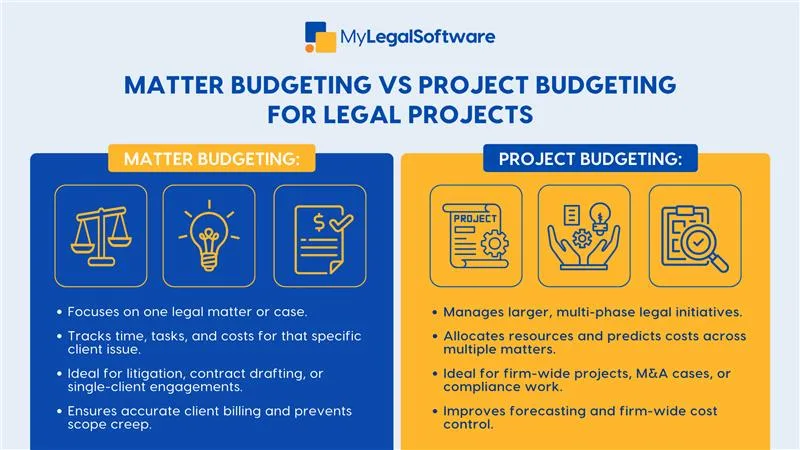
Matter budgeting focuses on estimating and managing the total cost of a legal matter from start to finish. It accounts for:
- All expected attorney and staff time
- Anticipated disbursements and vendor costs
- Major case milestones or phases
Matter budgeting legal projects provide a high-level financial roadmap, helping firms forecast total engagement costs, set client expectations, and monitor profitability at the matter level.
What Is Project Budgeting
Project budgeting, on the other hand, takes a granular approach. It breaks the matter into smaller, manageable phases. For example, “Discovery,” “Depositions,” or “Trial Preparation.” Each project within the matter has its own budget, timeline, and resources.
This approach allows for:
- Greater precision in legal project cost forecasting
- Better visibility into which phase drives most costs
- Faster identification of overruns before they spiral
Key Differences Between Matter and Project Budgeting
| Aspect | Matter Budgeting | Project Budgeting |
| Scope | Entire case or engagement | Specific phase or deliverable |
| Focus | Big-picture financial control | Day-to-day project execution |
| Flexibility | Suited for ongoing or retainer matters | Ideal for complex, phase-based work |
| Visibility | Firm-level financial forecasting | Detailed operational tracking |
Understanding this difference helps firms choose the right model or use both for maximum control.
Why Legal Budget Planning Fails Without the Right Tools
Traditional spreadsheets and manual tracking are prone to:
- Data entry errors
- Delayed updates
- Lack of real-time visibility
- Disconnected time and expense data
When you rely on outdated methods, forecasting becomes reactive instead of proactive. Legal budgeting software eliminates these inefficiencies by automating time tracking, expense capture, and real-time reporting.
How Legal Budgeting Software Improves Efficiency
A modern legal budgeting software integrates all your budgeting functions into one system. Here’s how:
- Automated Time Tracking: Every time entry updates the budget instantly.
- Custom Budget Templates: Set up matter or project templates to standardize forecasting.
- Budget Alerts: Get notifications when a matter nears its threshold.
- Integrated Reporting: Generate on-demand reports for clients and partners.
- Data Visualization: Track variances in dashboards that show exactly where money is being spent.
This automation not only improves accuracy but also helps attorneys focus on billable work rather than administrative tasks.
Real-World Example: How It Works in Practice
Imagine a corporate firm managing a multi-phase merger. The firm uses matter budgeting to set an overall engagement limit of $200,000. Within that, project budgets are created for:
- Due Diligence – $75,000
- Regulatory Filings – $50,000
- Negotiations – $50,000
- Closing and Post-Merger Tasks – $25,000
As work progresses, project-level tracking shows that due diligence is running ahead of schedule but slightly over budget. The team reallocates resources before the overrun affects the total matter budget. The client is informed proactively, no surprises, no write-offs.
Step-by-Step Guide to Implement Matter and Project Budgeting
- Define Objectives: Identify whether your firm’s goal is forecasting, profitability, or transparency.
- Categorize Work: Classify engagements by matter type and complexity.
- Set Templates: Build templates for both matter and project budgets using past data.
- Train Your Team: Ensure everyone logs time and expenses consistently.
- Monitor In Real Time: Use dashboards to review performance weekly.
- Adjust As Needed: Update forecasts as actuals evolve.
- Report Transparently: Share simplified reports with clients to build trust.
Benefits Of Using Legal Software for Budgeting
- Streamlined matter and project setup
- Real-time cost visibility
- Integrated attorney cost management tools
- Advanced analytics for legal budget planning
- Secure cloud access for remote teams
- Customizable reporting for different client needs
With the right legal system, your firm no longer has to choose between matter-level oversight and project-level precision; you get both.
Best Practices for Law Firm Adoption
- Start with a pilot group to fine-tune processes.
- Keep templates simple and scalable.
- Schedule monthly budget reviews to track progress.
- Create a culture of proactive communication with clients.
- Use KPIs like budget variance and realization rate to measure success.
Firms that adopt a structured budgeting process see measurable improvements in cost control, client satisfaction, and internal collaboration.
Final Thoughts: Choose the Right System
Matter budgeting and project budgeting are not competing concepts; they are complementary. Together, they create a complete system for legal matter cost forecasting and project budget forecasting.
When powered by MyLegalSoftware, this system gives your firm the ability to plan smarter, react faster, and deliver transparency your clients will value.
Schedule a free demo today to see how MyLegalSoftware can help your firm manage every case, client update, and budget, all in one place.

Frequently Asked Questions
-
What is the difference between matter budgeting and project budgeting?
Matter budgeting covers the full scope of an engagement from start to finish, while project budgeting divides that matter into smaller phases or deliverables (e.g., discovery, trial prep). Matter budgeting gives a high-level view; project budgeting gives tactical insight into costs by phase.
-
Can a law firm use both matter and project budgeting simultaneously?
Yes. Many firms adopt a hybrid approach: use matter budgeting for overall cost targets and client expectations, and project budgeting for high-risk or high-variance phases to monitor more closely.
-
How often should legal budgets be updated or reviewed?
Budgets should be reviewed regularly, weekly or monthly at a minimum. As new time and expense entries come in, forecasts should be updated so you don’t run blind into cost overruns.
-
What problems arise if a firm uses only spreadsheets for budgeting?
Spreadsheets are error-prone, don’t integrate with time & expense systems, lack real-time visibility, and make consolidation across matters or projects cumbersome. This limits timely decision-making and exposes the firm to budgeting surprises.
-
Which features should legal budgeting software offer for better cost control?
Some must-have features are:
- Real-time integration with time and expense capture
- Budget templates for reuse
- Forecasting and variance alerts
- Drill-down analysis (matter vs project)
- Client-facing reports or dashboards