Late one night, an associate at a mid-sized law firm sent an email before heading home, attaching client documents intended for internal review. By morning, his inbox was flooded with replies – the message had been sent to the wrong recipient.
What followed was a series of phone calls to IT, frantic requests to retract the message, and a very unhappy client. It’s the sort of mistake that could happen to anyone, and that’s exactly the problem.
In law, confidentiality goes beyond courtesy; it’s the foundation of trust. Yet the way many firms still handle files (through email attachments and unsecured drives) puts that trust at risk every day. What if your firm could manage every document, client update, and access permission in one secure, organized dashboard?
For law firms, secure file sharing has become the modern standard for protecting client data, preventing embarrassment, and keeping legal work efficient.
Why Security Is No Longer Optional
Law firms are, by their nature, vaults of private information. Inside those digital walls live personal histories, business secrets, financial records, and enough sensitive material to make a hacker’s year. The expectation of privacy is not only ethical but also legal. Clients assume their information is guarded, and regulators demand that it be. Still, many attorneys treat file sharing as an afterthought, something handled by the same email systems used for office holiday cards.
It’s not that lawyers don’t care about data security; it’s just that they are always busy. Between billable hours and case deadlines, few want to think about encryption or cloud protocols. But the risks are growing. Cyberattacks on law firms are increasing each year, and even a single data breach can damage a firm’s reputation, not to mention its client relationships.
Secure file sharing for lawyers is no longer a luxury; it’s a necessity. It’s as essential to a modern practice as conflict checks or malpractice insurance.
The Hidden Costs of Outdated Tools
Using traditional email attachments isn’t just risky; it’s inefficient. When files are shared across endless threads, confusion creeps in. Which version is the latest? Who has access to which folder? Did a former associate still have credentials after leaving the firm? These questions eat into valuable time and erode client confidence.
Then there’s the lack of accountability. Without a reliable audit trail, you can’t prove who viewed or downloaded a document. That can complicate everything from internal investigations to court-ordered discovery. And when breaches happen (as they inevitably do), the absence of logs can turn a bad day into a legal nightmare.
What Secure File Sharing Actually Does
Imagine a workspace where every document is encrypted in storage and in transit. Permissions are set by role, not by chance. Clients can log in through a secure portal, review drafts, upload evidence, and sign forms without ever touching email. That’s the promise of modern legal software, and it’s a far cry from shared drives and unprotected links.
Features That Make the Difference
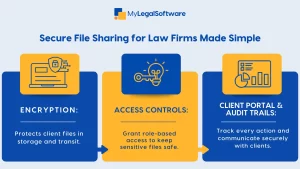
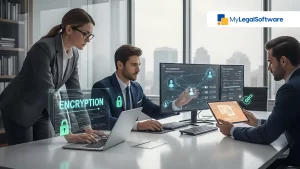
Encryption and Secure Storage: True security starts here. Encryption ensures that files are unreadable to anyone without authorization, both while being stored and during transfer.
Access Controls and Permissions: Each user gets access only to what they need. That means fewer accidental exposures and a clearer chain of responsibility.
Client Portals and Audit Trails: Instead of emailing attachments, clients and attorneys communicate within a secure system. Every action (a download, an edit, a signature) is logged automatically, creating a transparent record for compliance and peace of mind.
Integration with Case Management: The best file-sharing tools, like those built into MyLegalSoftware, connect directly to your cases. Files live where your work happens, saving time and reducing the chance of error.
Efficiency Without the Headache
Adopting secure file sharing isn’t about adding another layer of complexity. Done right, it simplifies the way a firm operates. Fewer lost documents mean fewer internal disputes and faster case progress. Remote teams can collaborate without relying on public cloud services that were never designed for attorney-client privilege. Even billing gets a boost: less time chasing files translates to more time on work that counts.
Bringing Security into Your Everyday Practice
Transitioning to secure file sharing doesn’t require an overhaul of your entire system. It starts with an audit of how files move through your firm — who sends what, where, and how. From there, setting up permissions and user roles ensures that documents are shared on a need-to-know basis. A good system lets you phase in adoption gradually: one team, one department, one client group at a time.
Training matters too. When attorneys and staff understand not just how to use the software but why it matters, compliance becomes part of firm culture rather than an IT policy. Even clients appreciate it; most would rather upload documents to a branded, secure portal than risk emailing confidential records.
Over time, the shift to secure file sharing changes more than just workflow. It signals professionalism. Clients notice. Regulators notice. And so do your competitors. In a field where trust is currency, showing that you value security gives your firm a real advantage.
The Bottom Line
A law firm’s reputation can take years to build and can get lost in minutes. Secure file sharing protects a reputation by safeguarding client data, ensuring compliance, and enhancing the daily workflow. It’s not just a technological upgrade; it’s a cultural one, where efficiency and integrity meet.
MyLegalSoftware was built with that goal in mind. It combines case management, client communication, and secure document sharing into one easy platform. Cloud-based, encrypted, and designed for lawyers, it helps firms of every size work smarter and safer.
If you want to protect your clients and free your team from the chaos of email attachments and unsecured drives, it’s time to see what modern file sharing looks like. Schedule a free demo and discover how MyLegalSoftware can keep your firm organized, compliant, and confidently secure.
Frequently Asked Questions
Can I just use email to share legal files?
While email is familiar, it is not secure enough for sensitive client information. Emails can be forwarded, stored on personal devices, or intercepted. Secure file sharing ensures documents are encrypted, tracked, and shared only with the intended recipients.
What features make file sharing secure for law firms?
Secure file sharing for lawyers includes end-to-end encryption, role-based access controls, audit logs of all activity, client portals for safe document exchange, and integration with case management systems. These features reduce errors, maintain confidentiality, and support compliance.
Is implementing secure file sharing difficult for law firms?
Implementation is manageable when done in phases. Start with one team or practice area, set clear permissions, migrate files carefully, and train staff. Most modern platforms, like MyLegalSoftware, are designed for easy adoption with minimal disruption.
How does secure file sharing benefit clients?
Clients can safely upload documents, review drafts, and provide e-signatures without using insecure email attachments. This not only protects their data but also enhances trust and makes communication faster and more efficient.
Will secure file sharing really improve my firm’s efficiency?
Yes. By reducing lost files, version confusion, and redundant communication, secure file sharing streamlines workflows. Staff can focus on billable work, deadlines are easier to meet, and collaboration with co-counsel and clients becomes smoother and faster.