

Starting a personal injury law firm in 2025 isn’t just an exciting professional step—it’s a bold entrepreneurial move. With the demand for personal injury lawyers continuing to grow across the U.S., more attorneys are leaving traditional firms and starting their own practices. Whether you’re a newly licensed attorney or an experienced litigator, launching your own personal injury law firm puts you in control of your clients, your time, your income, and your legacy.
But let’s be clear: building a successful personal injury firm in 2025 isn’t just about passion or experience. You need a clear strategy, strong infrastructure, and a firm grasp of legal marketing and technology. This guide will walk you through how to start a personal injury law firm, covering everything from legal setup and branding to client acquisition and growth; all optimized for today’s market.
Understanding the Personal Injury Law Landscape in 2025

Before diving into logistics, it’s important to understand the personal injury legal landscape. In 2025, personal injury law is more competitive, and more tech-driven than ever. With rising accident rates, medical malpractice claims, and work-related injuries, the demand for skilled personal injury attorneys remains steady.
But here’s the thing: clients are no longer just walking into law offices. They’re searching online, reading reviews, and comparing attorneys by their websites, content, and responsiveness. This means your law firm’s digital presence is just as important as your legal expertise.
Whether you’re starting a solo personal injury law firm or planning a boutique firm with partners, you’ll need to position your brand with clarity and authority from day one.
7 Essential Steps to Launch and Grow Your Personal Injury Law Firm in 2025
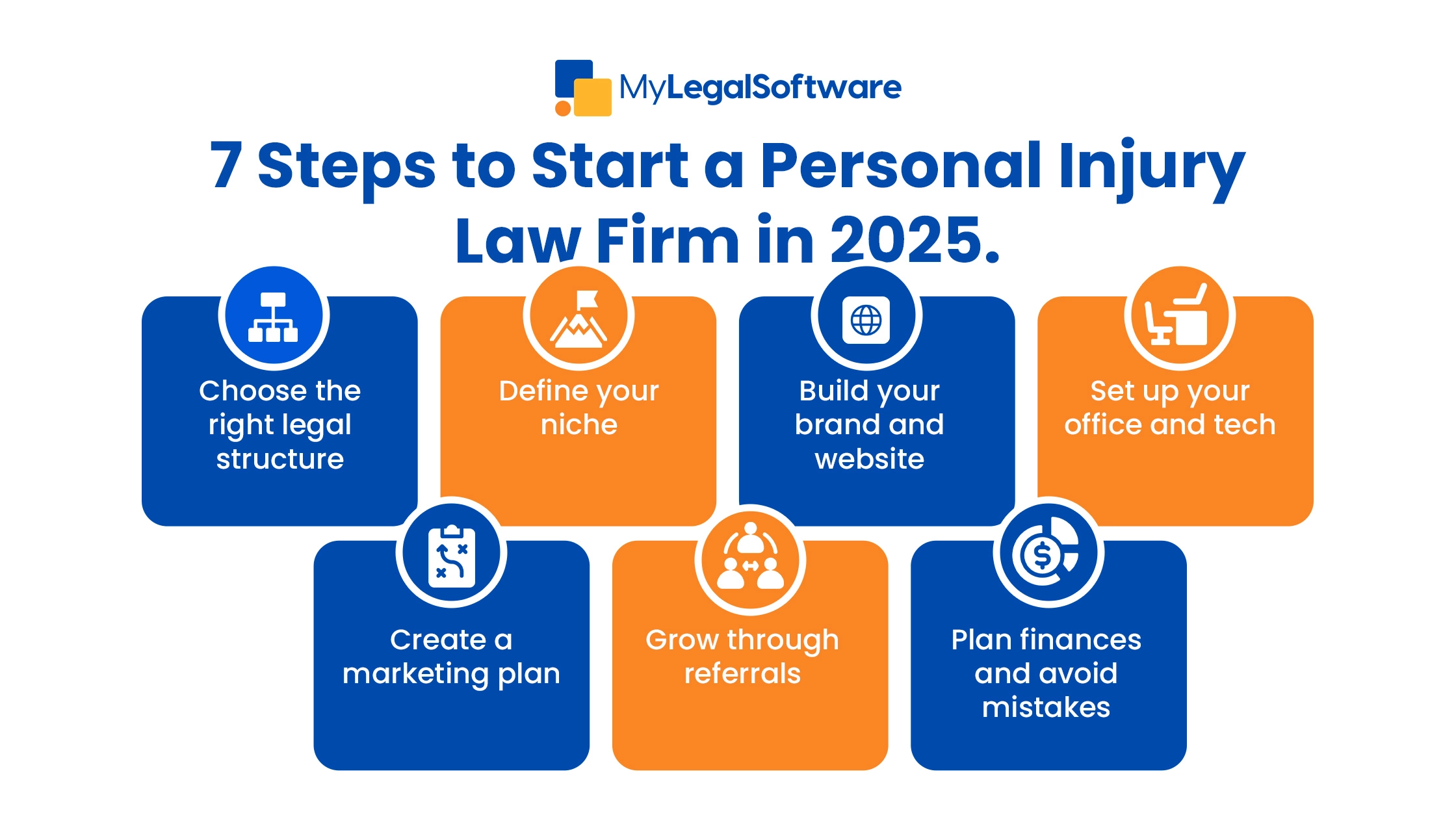
The whole process might feel overwhelming, but with the right plan, it’s completely doable. Whether you’re going solo or building a small team, these seven essential steps will guide you from legal setup to client acquisition, so you can launch a firm that’s professional, profitable, and built to grow in 2025.
Step 1: Choose the Right Legal and Business Structure
When you’re starting your own personal injury law firm, one of the first and most important decisions you’ll need to make is how to legally structure your business. This is more than just paperwork; it determines how your firm will be taxed, what your personal financial risk is, and how you’ll be seen in the eyes of the law and your clients.
So, what does this really mean?
Think of your business structure as the “legal wrapper” around your law firm. It tells the government, the IRS, your clients, and even potential business partners how your law firm operates. And most importantly, it protects you personally in case something goes wrong (like getting sued or facing debt).
What are your best options as a lawyer?
LLC (Limited Liability Company)
An LLC is one of the most common and beginner-friendly business structures. It’s flexible, easy to set up, and separates your personal finances from your business.
This means if your law firm is ever sued or goes into debt, your personal assets (like your house or car) are generally protected.
PC (Professional Corporation)
A PC is specifically for licensed professionals like lawyers, doctors, and accountants. It functions like a traditional corporation but is tailored for professional services.
Some states require attorneys to form a PC instead of an LLC, so you’ll need to check your state’s bar rules. Like an LLC, it protects your personal assets, but the set-up and tax rules can be a bit more complex.
What steps should you take?
Here’s a simple checklist to follow:
- Pick a name for your law firm that follows your state’s naming rules (many states require you to include “Law Offices of…” or “PLLC” in the name).
- Register your business with your state’s Secretary of State or appropriate office.
- Apply for an EIN (Employer Identification Number) from the IRS so you can file taxes and open a business bank account.
- Open a separate business bank account to keep personal and business finances apart (this is crucial for legal protection).
- Check with your state bar association to make sure your firm is in full compliance with licensing and ethical rules.
- Purchase malpractice insurance, also known as professional liability insurance; this protects you if a client claims you made a mistake or didn’t perform as expected.
In simple terms: If you want to protect yourself legally and financially, and start your firm the right way, setting up the right business structure–like an LLC or PC—is a non-negotiable first step.
Step 2: Define Your Niche and Brand Positioning
A common mistake many new personal injury lawyers make when starting their own law firm is trying to do too much at once. They want to help “everyone with injuries”—but that’s not how clients search or how trust is built in today’s digital world.
If your message is too general, like:
“We help injured people get compensation,”
you’ll sound like every other law firm.
But if your message is more specific, like:
“We represent car accident victims in Atlanta who’ve suffered spinal cord injuries,”
you’ll stand out, and attract people searching exactly for what you offer.
That’s what we mean by niching down, and in 2025, it’s not a limitation. It’s a smart marketing strategy.
What is a “niche” in personal injury law?
Your niche is the specific type of personal injury case or group of clients you want to focus on. Choosing a niche helps you:
- Get found more easily online (SEO)
- Build authority in that area of law
- Speak more clearly to your ideal client
- Grow faster with fewer marketing costs
Common and high-demand niches in personal injury law include:
- Car accident claims
- Medical malpractice
- Truck or commercial vehicle accidents
- Slip and fall cases
- Workers’ compensation cases
- Wrongful death lawsuits
These are not just common; they’re areas people actively search for on Google. Choosing one or two of these to focus on will help your law firm attract more clients faster.
How to position your brand in a crowded market
Once you’ve chosen your personal injury niche, the next step is building a strong brand that makes your firm memorable and trustworthy. Start with a law firm name that reflects your practice area or location—like “The Brooks Injury Law Group.” Add a professional logo, a bold tagline (e.g., “Justice for families. Results for life.”), and consistent colors to create a polished identity that stands out in a crowded personal injury law market.
Equally, your website is just as important. In 2025, your personal injury law firm needs a fast, mobile-friendly site that’s Search Engined Optimized (SEO) with relevant keywords. Make it easy to navigate, clearly list your services, include an “About” page, client reviews, and strong calls-to-action like “Book a Free Consultation.” Together, your brand and website should help build trust, boost search visibility, and convert visitors into clients.
Step 3: Set Up Your Office and Technology Stack
Whether you’re opening a physical office or launching a solo personal injury law firm from home, having the right tools and systems in place is essential. In 2025, many successful personal injury lawyers are operating fully remote or hybrid, saving costs while maintaining efficiency. What matters most isn’t your office size; it’s how organized and professional your operations are. Start by investing in a legal practice management software like MyLegalSoftware to handle cases, deadlines, and communications all in one place.
Next, build a smart, secure tech setup. Use cloud-based storage to safely manage client documents, and tools like e-signature and e-billing software to speed up paperwork and payments. Consider hiring a virtual receptionist or intake staff to respond to new inquiries quickly and professionally. Also, use a professional email address tied to your law firm’s domain; it builds trust. These tools make your personal injury law firm look polished and run smoothly, even if you’re just starting out.
Step 4: Build a Personal Injury Marketing Plan That Works
Being a skilled attorney isn’t enough if people can’t find you. In 2025, building a strong marketing strategy for your personal injury law firm is essential—not just to stand out locally, but online. Your goal is to build visibility, trust, and consistent leads. Here’s what works:
- Local SEO: Optimize your website with keywords like “[Your City] personal injury lawyer” so people searching in your area can find you. Also, set up and fully complete your Google Business Profile; this helps you show up in local map results and builds credibility.
- Content marketing: Write helpful blog posts that answer real client questions, such as “How much do personal injury attorneys charge?” or “How do I file a personal injury claim?” This improves your search rankings and builds trust with potential clients.
- Social proof: Ask happy clients to leave reviews on Google, Avvo, and legal directories. Positive feedback acts as digital word-of-mouth and helps your personal injury law firm stand out from the competition.
- Pay-per-click advertising: Use Google Ads or Local Services Ads to appear at the top of search results. This is a great way to generate leads while your website and SEO efforts grow organically.
- Email marketing: Send newsletters with legal tips, case wins, or personal injury updates. It keeps your firm on top of mind and positions you as a helpful, trusted attorney, even before someone needs a lawyer.
Even if you’re working with a small marketing budget, focusing on these key areas will give your solo personal injury law firm the visibility and client flow it needs to grow.
Step 5: Grow Through Referrals and Relationships
One of the easiest and most effective ways to grow your personal injury law firm is by building strong relationships that lead to referrals. Connect with other lawyers who don’t handle personal injury cases, as well as medical professionals like chiropractors and therapists who regularly work with accident victims. Insurance adjusters and case managers can also be great referral sources. Join local bar associations, attend legal events, and don’t hesitate to let people know you’re open to referrals. When people know, like, and trust you, they’re more likely to send clients your way.
Step 6: Plan Your Finances and Scaling Strategy
Starting a personal injury law firm comes with upfront costs, and it’s important to plan wisely. For a solo personal injury firm, expect to spend around $500–$1,500 on business registration and licenses, $2,000–$5,000 per year on malpractice insurance, and $3,000–$10,000 for your website and initial marketing. If you’re renting office space, prices will vary depending on your location. You’ll also need to budget about $100–$300 per month for essential legal software tools.
Many attorneys choose to self-fund their firm, but small business loans or lines of credit are also common. Since most personal injury firms operate on a contingency fee model, you might not get paid until you win and settle a case—so plan for a few months without income. Tools like QuickBooks or Xero can help you track expenses, and hiring an accountant who understands law firm finances can save you time and stress as you grow.
Step 7: Avoid Common Mistakes New Law Firms Make
Starting your own personal injury law firm is exciting, but it’s easy to make avoidable mistakes that can slow your growth. One major mistake is skipping essential requirements like malpractice insurance or missing key state filings—these can put your practice at risk. Many new attorneys also underestimate how long it takes to start getting clients, especially with a contingency fee model, so it’s important to plan your finances carefully.
Don’t try to handle everything alone. Outsource tasks like accounting, marketing, or virtual intake when needed, so you can focus on the most important things. Also, be sure to define your niche and brand clearly—general messaging won’t help you stand out. Finally, don’t neglect your digital marketing or the client experience; both play a huge role in building trust and bringing in referrals. Remember: running a successful law firm means thinking like both a lawyer and a business owner.
Final Thoughts On Starting a Personal Injury Law Firm in 2025
Starting a personal injury law firm in 2025 is not only possible—it’s a smart move if you’re prepared. With the legal landscape shifting and modern tools making it easier than ever to run lean, efficient firms, solo and small law practices have a real chance to compete and thrive. Success comes from more than legal expertise—it requires a clear niche, standout branding, smart marketing, and careful financial planning.
Whether you’re launching a solo personal injury practice or growing a small team, treat your law firm like a business from the start. Build strong relationships, deliver value consistently, and prioritize the client experience—because trust and referrals will drive your growth. And when it comes to managing your operations, especially billing and alternative fee arrangements, using the right tools can make all the difference.
That’s where MyLegalSoftware comes in. From automated workflows and secure client portals to flat-rate billing and easy task tracking, MyLS is built to support any fee structure—helping you run smarter, not harder.
Start your free 14-day trial and discover how better systems can transform the way you manage and grow your personal injury law firm.
FAQs (Frequently Asked Questions)
-
-
Do I need to be an experienced attorney to start my own firm?
-
No, you don’t. While experience helps, many newly licensed attorneys are successfully launching their own firms. The key is having the right legal structure, clear niche, solid marketing, and tools to run efficiently.
-
-
What’s the best business structure for a new personal injury law firm?
-
Most attorneys choose an LLC or Professional Corporation (PC). Both offer personal liability protection and tax advantages. Your choice may depend on your state bar rules, so check what’s required in your jurisdiction.
-
-
How much money do I need to start?
-
You can start with $5,000 to $15,000, depending on your setup. Virtual firms cost less, but you’ll still need to invest in things like business registration, malpractice insurance, a website, and marketing tools.
-
-
How do I start getting clients?
-
Start with local SEO (optimize your website for “[Your City] personal injury lawyer”), build a complete Google Business Profile, and ask past clients for reviews. Add helpful blog content and consider Google Ads for faster visibility.
-
-
Do I need an actual office, or can I work remotely?
-
You can absolutely work remotely. Many personal injury lawyers in 2025 run lean, virtual firms using legal software like MyLS, cloud tools, and virtual assistants. What matters more than a physical office is how organized and responsive you are.