

It is late in the afternoon, the phones are quieter, and a lawyer finally has a moment to breathe. Then the call comes. Not about strategy. Not about next steps. It is about the invoice.
The client is polite but puzzled. They do not quite understand what they are looking at, and the explanation takes longer than anyone would like. By the time the call ends, goodwill has thinned, and no one feels better about how the conversation went.
This is where many law firms find themselves, not because they did anything wrong legally, but because their law firm invoice failed to do one simple thing: communicate clearly.
What if your billing process worked as smoothly as your legal reasoning, and your invoices quietly reinforced trust instead of testing it?
The Trust Problem Hidden Inside Legal Invoices
Billing is one of the few moments when a client evaluates your work without seeing the work itself. They cannot assess the research, the negotiations, or the strategy choices. All they have is the legal invoice in front of them.
When that document feels confusing or overly technical, clients fill in the gaps themselves. They wonder whether time was tracked accurately or whether the process is as organized as it should be. Even excellent legal work can feel less solid when the law office invoice looks uncertain.
Clear invoices do the opposite. They reassure clients that their matter is being handled thoughtfully and responsibly, down to the smallest detail.
Transparency is not a trend in legal billing. It is an expectation. Clients want to see what was done, when it was done, and why it mattered. When they do, trust grows quietly and consistently.
Why Clients Read Invoices So Closely
Clients may skim emails and updates, but they study invoices. A legal invoice is personal because it asks for payment and justification at the same time. If the language is vague or the structure feels improvised, doubt creeps in.
A clear law firm invoice respects the client’s intelligence. It explains services in plain language, shows time entries that make sense, and reflects the billing agreement that was discussed at the beginning of the relationship.
That clarity signals professionalism in a way no marketing brochure ever could.
How Clear Invoices Actually Reduce Conflict
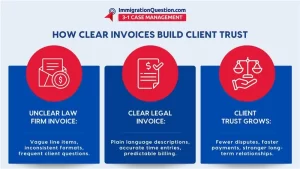
Most billing disputes are not about money. When clients are surprised by totals or line items, they ask questions. When questions pile up, frustration follows. The firm then spends non-billable time explaining what should have been clear from the start.
Clear legal invoices reduce those moments before they happen. They make billing predictable, understandable, and easier to accept.
The Role of Software in Better Billing
This is where modern legal software quietly earns its keep. By connecting time tracking, case management, and billing in one system, firms reduce the chance of errors and omissions that undermine confidence.
Instead of reconstructing time at the end of the month, attorneys capture work as it happens. Instead of inconsistent formats, every law office invoice follows the same professional structure. Instead of cryptic notes, descriptions are written with the client in mind.
The result is not just a better invoice. It is a calmer relationship.
What Clients Notice Right Away
Clients notice when invoices arrive on time. They notice when descriptions are clear. They notice when charges align with what was discussed earlier.
They also notice when they do not need to call your office for clarification. That absence of friction is one of the strongest trust builders a firm can have.
From Traditional Billing to Modern Legal Invoicing
Many law firms still rely on familiar tools like spreadsheets, word processors, or disconnected accounting platforms. These systems work, until they do not. They invite inconsistency, manual errors, and delays that chip away at confidence.
Modern legal software changes the rhythm of billing entirely. Time entries flow directly into invoices. Rates apply automatically. Case details stay connected to charges, which makes every legal invoice easier to review and easier to understand.
Best Practices That Make a Difference
Clear invoicing is not only about technology. It is also about habits. Firms that succeed tend to standardize how time entries are written, train staff to think from the client’s perspective, and review invoices with the same care they give legal documents. Software supports these practices, but leadership sets the tone.
When billing becomes part of the client experience, rather than an afterthought, trust follows naturally.
A Quiet Competitive Advantage
In a crowded legal market, clients remember how they feel. They remember whether interactions felt respectful or stressful. Billing plays a larger role in that memory than many firms realize.
Clear law firm invoices show clients that your firm values transparency, organization, and fairness. They reduce disputes, speed up payments, and strengthen long term relationships.
Most importantly, they allow your legal work to stand on its own, without billing confusion getting in the way.
If your firm is ready to make invoicing a source of trust instead of tension, it may be time to rethink the tools behind it.
Schedule a free demo to see how ImmigrationQuestion.com 3-1 Case Management helps law firms create clear, professional legal invoices that clients understand and trust.
Frequently Asked Questions
Why do clear invoices matter to law firm clients?
Clear invoices help clients understand exactly what they are paying for, which reduces confusion, prevents disputes, and builds trust in the firm’s professionalism.
What should be included in a law firm invoice?
A law firm invoice should include detailed service descriptions, accurate time entries, billing rates, dates of work performed, and a clear total that matches the engagement agreement.
How do unclear legal invoices affect client relationships?
Unclear legal invoices can create doubt and frustration, leading clients to question billing accuracy and, over time, weakening trust in the firm.
Can legal software improve invoice clarity?
Yes. Legal software centralizes time tracking and billing, standardizes invoice formats, and reduces errors, resulting in clearer and more consistent invoices.
Do clear invoices help law firms get paid faster?
They do. When clients understand their invoices, they are more likely to approve and pay them promptly, improving cash flow for the firm.