

Court case management software is a digital powerhouse that streamlines judicial workflows in modern courts by automating case tracking, document handling, scheduling, and collaboration, transforming chaotic paper trails into efficient, real-time operations.
Imagine a courthouse that has already seen better hours. A clerk is hunting for a file that was updated yesterday, an attorney is waiting for confirmation that a hearing was rescheduled, and a judge is asking a familiar question: why does something so routine still take so long? Courts, like many public institutions, carry the weight of tradition.
Paper files, legacy systems, and disconnected tools have lingered well past their usefulness. The frustration is not dramatic, just constant. And it raises a practical question.
What if courts could manage every case, document, and deadline in one reliable system that keeps pace with modern demands?
What Court Case Management Software Really Is and Why It Matters
Court case management software is not merely a digital filing cabinet dressed up with legal language. At its best, it is the operational backbone of a modern court. It allows cases to be created, tracked, updated, and resolved within a single platform, replacing the patchwork of paper records, spreadsheets, and siloed databases that slow judicial work.
This type of software follows a case from its first filing through hearings, motions, rulings, and final disposition, ensuring that everyone who needs access to accurate information can find it without delay.
The importance of court case management software becomes clearer when compared with traditional methods. Manual systems depend heavily on repetition, memory, and individual workarounds.
Information is entered multiple times, schedules are updated by hand, and documents move slowly between offices.
Modern court management software reduces these friction points by centralizing data and automating routine processes. The result is not just efficiency, but consistency.
Courts gain a clearer view of their caseloads, staff spend less time correcting errors, and judges can focus on decision-making rather than document chasing.
How Court Case Management Software Works in Modern Courts
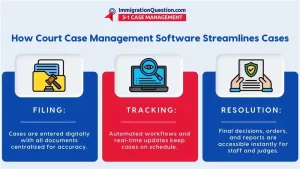
In practice, court case management software functions as a shared source of truth. Cases are initiated electronically, often through e-filing systems, with required information captured once and reused throughout the life of the case.
Documents are stored securely in a centralized repository, where authorized users can access filings, orders, and notes without wondering whether they are looking at the latest version.
Scheduling tools coordinate hearings, deadlines, and courtroom availability, while automated workflows help ensure that tasks move forward without unnecessary delays.
Modern court software solutions also emphasize visibility and accountability. When a case status changes, that update is reflected immediately across the system.
Notifications replace informal reminders, and dashboards provide real-time insight into workloads and bottlenecks.
Over time, reporting and analytics tools allow court administrators to see patterns that were previously buried in paper files.
This is where full court case management begins to show its value, not as a convenience, but as a management instrument that supports better planning and public accountability.
Key Capabilities That Support Daily Court Operations
While features vary, most court case management software shares a common goal: to make routine work more predictable and less error-prone.
Case tracking tools offer a clear view of progress, document management functions reduce drafting and filing mistakes, and security controls protect sensitive information through defined user permissions.
Integration with other systems, including financial and government platforms, helps courts avoid duplicating work and keeps data consistent across departments.
These capabilities may not attract headlines, but they quietly shape how effectively a court serves its community.
Full Court Case Management Versus Fragmented Systems
The distinction between full court case management and fragmented systems is often the difference between progress and perpetual frustration.
Fragmented systems rely on separate tools for filings, scheduling, and records, each with its own data set and learning curve. Information must be transferred manually, increasing the risk of delays and discrepancies.
Full court case management brings these functions together within one platform, creating a continuous workflow that reduces handoffs and confusion.
For courts, this unified approach supports long-term stability. Training becomes simpler, data remains consistent, and accountability is easier to establish.
Over time, courts using full court case management software are better positioned to adapt to policy changes, caseload growth, and public expectations for transparency.
Implementing Court Case Management Software Successfully
Adopting court case management software is as much an organizational effort as a technical one. Successful implementations begin with an honest assessment of existing processes, followed by clear goals that define what the court hopes to improve.
Training is critical, not as a one-time exercise, but as an ongoing investment that helps staff feel confident using the system. Many courts benefit from phased rollouts, which allow teams to adjust gradually while maintaining continuity of operations.
When staff understand how the software supports their daily work, adoption tends to follow.
The Practical Next Step
Court case management software has moved from being an optional upgrade to being an institutional necessity. By replacing fragmented processes with a unified system, courts can reduce delays, limit errors, and make better use of their most valuable resource: time. The shift is not about abandoning tradition, but about giving the justice system tools that match its responsibilities.
ImmigrationQuestion.com 3-1 Case Management provides court software solutions designed to support real-world judicial workflows with security, scalability, and clarity. Schedule a free demo to see how ImmigrationQuestion.com 3-1 Case Management can help modernize your court’s case management process.

Frequently Asked Questions
1.What Is Court Case Management Software?
Court case management software is a digital platform that helps courts organize and track cases from filing to resolution. It centralizes documents, schedules, and updates so judges, clerks, and administrators can work from the same accurate information.
2. How Does Full Court Case Management Differ from Fragmented Systems?
Full court case management integrates filing, scheduling, document management, and reporting into one system, reducing handoffs and errors. Fragmented systems rely on multiple disconnected tools, increasing delays and administrative work.
3. What Are the Key Benefits of Using Court Case Software?
The main benefits include faster case processing, fewer errors, clearer visibility into caseloads, better workflow coordination, and improved public confidence through consistent, accountable operations.
4. Can Court Case Management Software Integrate with Other Systems?
Yes. Most court software solutions integrate with e-filing platforms, financial systems, and government databases, creating a seamless workflow and avoiding duplicate work.
5. How Do Courts Implement Court Case Management Software Successfully?
Successful adoption involves assessing current processes, setting clear goals, providing ongoing staff training, and rolling out the system in phases to ensure smooth transition and minimal disruption.