

It’s late at the office and a legal assistant is still toggling between email threads, spreadsheets, and folders labeled “Final_3.” Somewhere in all that digital clutter is the document an attorney needs first thing in the morning. No one planned for the scramble, but it has become routine. This is how inefficiency quietly settles into a law firm and starts billing hours that no client will ever see. The question many firms eventually face is whether free tools are truly saving money or quietly draining it.
At some point, every practice confronts the same crossroads. You can keep stitching together free software and manual processes, or you can invest in a system designed to hold everything together. The difference shows up not in theory, but in how smoothly the workday unfolds.
Why Case Management Software Shapes a Law Firm’s Future
Law practice has changed, even if some office habits have not. Clients expect timely updates, courts demand precision, and compliance requirements leave little room for error. Case management software is no longer a luxury reserved for large firms. It has become the infrastructure that determines whether a small or mid-sized practice runs with intention or improvisation.
Modern law firm case management software brings order to what would otherwise be a scattered operation. Cases, contacts, deadlines, documents, and billing live in one system, accessible without guesswork. When firms rely instead on disconnected tools, the cost appears slowly. Missed reminders, duplicated work, and preventable mistakes accumulate until they feel normal. That normalization is where risk takes root.
The Allure and Limits of Free Legal Case Management Software
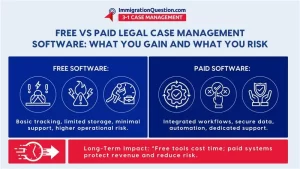
Free attorney case management software often looks like a sensible starting point, especially for new firms watching every expense. These platforms typically cover the basics, offering simple case tracking, task lists, and limited document storage. For a time, that may be enough. The firm feels organized, at least compared to paper files and email searches.
The trouble begins when the practice grows or simply gets busy. Free legal case management programs rarely evolve at the same pace as a working law office. Storage caps are reached, features feel rigid, and support is either minimal or nonexistent. Security practices may be vague, and integrations with billing, calendars, or client communication tools are often missing. What started as a cost-saving measure becomes a patchwork system that demands constant attention and workarounds.
Where Free Tools Quietly Shift Risk
The real cost of free law practice management software is not measured in subscription fees. It shows up in lost time, increased stress, and exposure to errors that could have been avoided. When something breaks or data is lost, responsibility rests squarely with the firm. Free tools rarely offer the assurances that legal professionals depend on when managing confidential information.
What Paid Legal Case Management Software Gets Right
Paid legal case management software approaches the problem from a different premise. It assumes that law firms need systems that reflect how legal work actually happens. Instead of isolated features, it offers integrated workflows that connect case management, document handling, time tracking, billing, and client communication.
The best legal case management software creates a single source of truth. Attorneys and staff know where to find information and trust that it is current. Automated reminders reduce the chance of missed deadlines, while built-in reporting offers visibility into workloads and revenue. Security is not an afterthought. It is part of the design, supported by encryption, backups, and compliance standards that protect both the firm and its clients.
Efficiency That Translates into Billable Work
One of the strongest arguments for paid lawyer case management software is time. When routine tasks are streamlined, attorneys reclaim hours that would otherwise disappear into administrative friction. Time tracking becomes more accurate, billing delays shrink, and client communication improves without additional effort. Over months, the gains are measurable, even for small firms.
Making The Transition Without Disruption
Adopting new law office management software does not require turning the firm upside down. The most successful transitions begin with a clear assessment of pain points, followed by careful data migration and focused training. Staff do not need to master every feature on day one. They need to understand how the system supports their daily responsibilities.
As workflows settle into the new platform, firms often discover opportunities to standardize processes that were previously inconsistent. Over time, the software becomes less of a tool and more of an operating system for the practice.
Choosing What You Gain and What You Risk
Free legal case management software can serve as a temporary bridge, but it often shifts cost into less visible places. Paid legal case management software, by contrast, is an investment in stability, efficiency, and long-term growth. It reduces uncertainty and allows legal professionals to focus on their work instead of their workarounds.
For firms ready to move beyond improvisation, the next step is simple. Schedule a free demo with ImmigrationQuestion.com 3-1 Case Management and see how a unified system can bring clarity and control back to your law practice.

Frequently Asked Questions
- What Is Legal Case Management Software?
Legal case management software helps law firms organize cases, documents, deadlines, billing, and client communication in one centralized system.
- Is Free Legal Case Management Software GoodforSmall Law Firms?
Free software can work for very small or new firms, but it often lacks security, scalability, and support as caseloads grow.
- What AretheRisks of Using Free Attorney Case Management Software?
Common risks include limited storage, weak data protection, missing integrations, and no guaranteed customer support if problems arise.
- Why Do Law Firms Choose Paid Case Management Software?
Paid legal case management software saves time, reduces errors, improves billing accuracy, and provides stronger security and compliance protections.
- How Do I ChoosetheBest Legal Case Management Software for My Firm?
Look for software that fits your firm size, integrates case management and billing, offers strong security, and supports your workflow as the firm grows.