

Most lawyers do not wake up thinking about software. They think about deadlines, clients who need answers, and the quiet pressure of getting everything right. Somewhere along the way, usually after one too many missed reminders or misplaced files, a firm reaches for free case management software. It feels practical, even responsible. Why pay for something when a free option seems to keep the lights on? But legal work has a way of exposing weak systems. What starts as “good enough” often becomes the very thing slowing a firm down.
The Appeal of Free Tools and the Reality Behind Them
Free case management tools can be genuinely helpful at the beginning. For solo attorneys or very small firms, they offer a first step away from chaos. Cases get listed, tasks get tracked, and nothing feels completely out of control. The problem is that these tools are not useless. The problem is that they are limited by design. They are rarely built for the way law offices operate, where deadlines are unforgiving and details matter more than convenience.
As the caseload grows, cracks begin to show. Attorneys find themselves updating information in multiple places, tracking time separately, and relying on memory instead of systems. What looked like savings starts to cost time. In a profession where time is literally money, that tradeoff is not trivial.
Why Time and Focus Matter More Than Monthly Fees
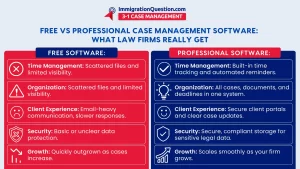
Legal work depends on concentration. Every interruption, every manual workaround, pulls attention away from analysis and advocacy. Free software often lacks features that support real efficiency, like built-in time tracking, automated reminders, or clear case overviews. Lawyers end up doing administrative work that could have been handled quietly in the background. The monthly cost of professional software suddenly looks small compared to the hours lost each week.
There is also the matter of confidence. Clients expect their lawyers to be organized and responsive. When systems are clunky, response times slow down. Documents take longer to find. Updates feel less certain. These are small things individually, but together they shape how clients experience a firm.
What Purpose-Built Legal Software Actually Changes
Professional legal case management software is designed around the reality of legal practice, not generic task lists. It brings cases, documents, deadlines, billing, and communication into one place, so nothing falls through the cracks. Attorneys can see the full picture of a matter without jumping between tools. Time tracking happens naturally as work is done. Client communication becomes more structured and secure.
The difference is practical. Work flows more smoothly. Staff spend less time searching and more time doing meaningful tasks. Partners gain visibility into what is happening across the firm without micromanaging. Over time, these improvements compound.
Growing Without Outgrowing Your Systems
One of the quiet problems with free tools is how quickly they get outgrown. Adding staff or taking on more cases often means inventing new workarounds. Data becomes harder to manage. Training becomes inconsistent. Eventually, a firm has to switch systems, usually under pressure. Purpose-built law firm software is designed to grow with the practice, not hold it back.
So, Is Free Case Management Software Enough?
For a short season, it can be. For firms with real workloads, real clients, and real ambitions, it rarely is. Free tools may organize information, but they do not support the full weight of legal practice. Professional software does more than store data. It protects time, reduces risk, and allows lawyers to focus on the work that only they can do.
At ImmigrationQuestion.com, we built our platform for firms that want clarity instead of clutter. Everything from case tracking to billing and client communication lives in one secure system, designed to support how lawyers work.
If your current setup feels like it is barely keeping up, that feeling is worth listening to.
Schedule a free demo today and see how ImmigrationQuestion.com 3-1 Case Management can help your firm work with confidence and control.

Frequently Asked Questions
Is Free Case Management Software Safe for Lawyers?
Free case management software can be safe at a basic level, but it often lacks the security standards law firms rely on, such as advanced encryption, controlled access, regular backups, and compliance support. For firms handling sensitive client data, these gaps can create unnecessary risk over time.
What Are the Limitations of Free Case Management Software for Law Firms?
Most free tools offer limited features, little to no customer support, and poor scalability. Common limitations include no built-in time tracking, weak document management, limited automation, and difficulty supporting multiple users as a firm grows.
Can Small Law Firms Use Free Case Management Software Long Term?
Small law firms can use free software temporarily, especially during the early stages. Long term use often becomes challenging as caseloads increase, administrative tasks grow, and clients expect faster, more organized communication.
How Does Paid Legal Case Management Software Improve Productivity?
Paid legal software centralizes cases, documents, billing, and communication in one system. This reduces manual work, prevents missed deadlines, captures billable time more accurately, and allows attorneys to spend more time on legal work instead of administration.
When Should a Law Firm Upgrade from Free Software?
A firm should consider upgrading when it starts managing multiple active cases, working with staff, billing clients regularly, or experiencing delays caused by manual processes. If software feels like it is slowing the firm down rather than supporting it, that is usually the right moment to move to a professional solution.