Billing is the lifeblood of law firms. But many firms still rely on spreadsheets, manual templates, or generic accounting tools. And that’s a problem.
Legal invoicing software is a necessity. It helps you capture billable time, track expenses, generate professional invoices, collect payments faster, and maintain compliance. In short, it makes billing quicker and reliable.
Let’s break down why law firms need it, how it works, and what benefits it delivers.
Importance of Legal Invoicing Software
Law firm billing can be complicated. Attorneys log hours, track expenses, and manage retainers. Add multiple billing rates, approval processes, and client expectations, and it’s easy for errors and delays to creep in.
Slow invoicing, missed billable time, and poor follow-up on collections are among the biggest challenges firms face. These issues affect cash flow, client satisfaction, and overall profitability.
Legal invoicing software fixes this. It automates workflows and keeps all your billing data in one place. That means fewer disputes, faster payments, and better visibility for firm leaders.
Capabilities of Legal Invoicing Software
-
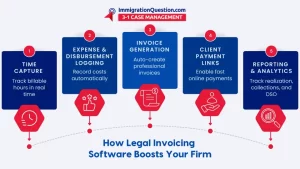
Time Capture & Tracking
Accurate time logging is the foundation of billing. Modern software lets attorneys log time live, use mobile entry, or bulk upload entries.
And it’s not just about logging hours. Automated timers, reminders, and matter-linked tracking reduce missed entries and increase revenue.
-
Expense & Disbursement Tracking
Court fees, travel, copies, and other expenses are part of the job. Legal invoicing software ties these directly to matters, so they appear automatically on invoices—no more missing billables.
-
Invoice Generation & Templates
Generate invoices in seconds. Choose from itemized entries, matter codes, retainer balances, and payment terms. Most systems support tax calculations and custom branding.
Consistent, professional invoices improve client experience and encourage payment.
-
Billing Codes & Rate Management
Different attorneys, paralegals, and tasks often have different rates. Software supports rate matrices, overrides, and task codes.
This standardization allows firms to measure realization, which is the percentage of recorded time that actually gets billed, and improve profitability tracking.
-
Billing Schedules & Recurring Billing
Scheduling automated invoices helps keep cash flow predictable for retainers, subscriptions, and recurring clients.
-
Client Statements & Aging Reports
Dashboards show receivables, overdue invoices, and payment trends. Firms can prioritize collections and reduce days sales outstanding (DSO).
-
Trust Accounting Integration
For firms handling client funds, legal invoicing software ensures compliance. Trust retainers are applied correctly, and integrated workflows reduce ethical risk.
- Payments & Payment Links
Clients expect convenience. Embedded payment links, ACH, or card options help you collect faster. Firms that use online payments consistently outperform those that use manual methods.
How Legal Invoicing Software Benefits Law Firms
-
Improves Cash Flow
Invoices are issued faster, and payments are received more quickly. Your liquidity improves.
-
Reduces Billing Errors
Automation reduces mistakes, adjustments, and write-offs.
-
Enhances Financial Visibility
Dashboards track realization, collection rates, matter profitability, and partner performance. You can view all at a glance.
-
Supports Pricing Strategies
Analyze time and revenue patterns to adjust rates, adopt blended fees, or implement alternative fee arrangements (AFAs).
-
Improves Client Experience
Clients get clear, professional invoices with easy payment options. Fewer questions. Fewer disputes. Happier clients.
Common Billing Challenges & Software Solutions
- Missed Time Entries: Live timers and matter-linked logs prevent leakage.
- Manual Invoice Assembly: Software generates invoices automatically.
- Lack of Standardization: Templates and coding rules enforce uniformity.
- Collection Follow-Up: Dashboards and alerts streamline the management of overdue invoices.
Choosing the Right Legal Invoicing Software
Look for these key criteria:
- Usability: Attorneys need intuitive, distraction-free interfaces.
- Integration: Works with time tracking, documents, and calendaring.
- Reporting & Analytics: Realization, aging, collection metrics, and custom reporting.
- Trust & Compliance: Retainer and trust management built in.
- Security: Encryption, access controls, and audit logs.
- Workflow Automation: Late fees, discounts, and approvals are enforced automatically.
Implementation Best Practices
- Standardize Codes & Templates First – Makes deployment easier.
- Train Staff Early & Often – Short sessions, reference guides, champions.
- Pilot Teams or Matters – Test before full deployment.
- Assign Governance – A billing manager ensures policies and reports are consistent.
Metrics to Track After Implementation
- Days Sales Outstanding (DSO) – Faster collection is better.
- Realization Rate – Billed revenue versus entered time.
- Collection Rate – Collected revenue versus billed.
- Invoice Cycle Time – How quickly invoices go out.
- Write-Off Percentage – Minimize lost revenue.
- Aging Buckets – Monitor invoices 30/60/90+ days overdue.
Industry Trends Shaping Legal Billing
- Alternative Fee Arrangements (AFAs): Fixed, blended, subscription billing requires flexible software.
- Remote Work: Cloud-based platforms support hybrid teams.
- Client Payment Expectations: Online payments, ACH, and e-billing are now standard.
ImmigrationQuestion.com 3-1 Case Management as The Smart Choice
ImmigrationQuestion.com 3-1 Case Management offers legal invoicing for modern law firms. It combines time capture, billing, trust management, and analytics in one platform. You get professional templates, automated workflows, online payments, and dashboards to track collections and performance.
Stop losing revenue to slow billing. Start billing smarter.
Schedule a demo or start a free trial today.

Frequently Asked Questions
What is legal invoicing software?
Legal invoicing software is a specialized tool for law firms that automates billing, tracks time and expenses, and generates professional invoices. It integrates with case management and helps manage collections.
How does legal invoicing software improve cash flow?
By automating invoice creation and delivery and providing online payment options, firms reduce delays and shorten DSO, enabling clients to pay faster.
Can legal invoicing software reduce billing errors?
Structured templates, automated rate application, and matter-linked entries minimize mistakes, adjustments, and write-offs.
Can small or solo law firms use it?
Modern legal invoicing software scales to any firm size. Even small teams benefit from automation, templates, and reporting dashboards.
How does it integrate with other law firm software?
Most solutions connect with practice management systems, time tracking, calendaring, document management, and CRM tools, keeping all billing data in one place. ImmigrationQuestion.com 3-1 Case Management is a one-stop tool.
What reporting and analytics does it provide?
Essential metrics include realization rate, collection rate, DSO, invoice cycle time, write-off percentages, and accounts receivable aging, enabling better financial decisions.
How secure is legal invoicing software?
Top platforms offer encryption, role-based access, audit logs, and compliance with data protection standards to protect sensitive client information.
Why should my firm invest in legal invoicing software now?
Billing inefficiencies directly affect revenue, client satisfaction, and cash flow. Adopting purpose-built software speeds invoicing, reduces errors, improves reporting, and ensures compliance. All these are necessary for modern law firms.